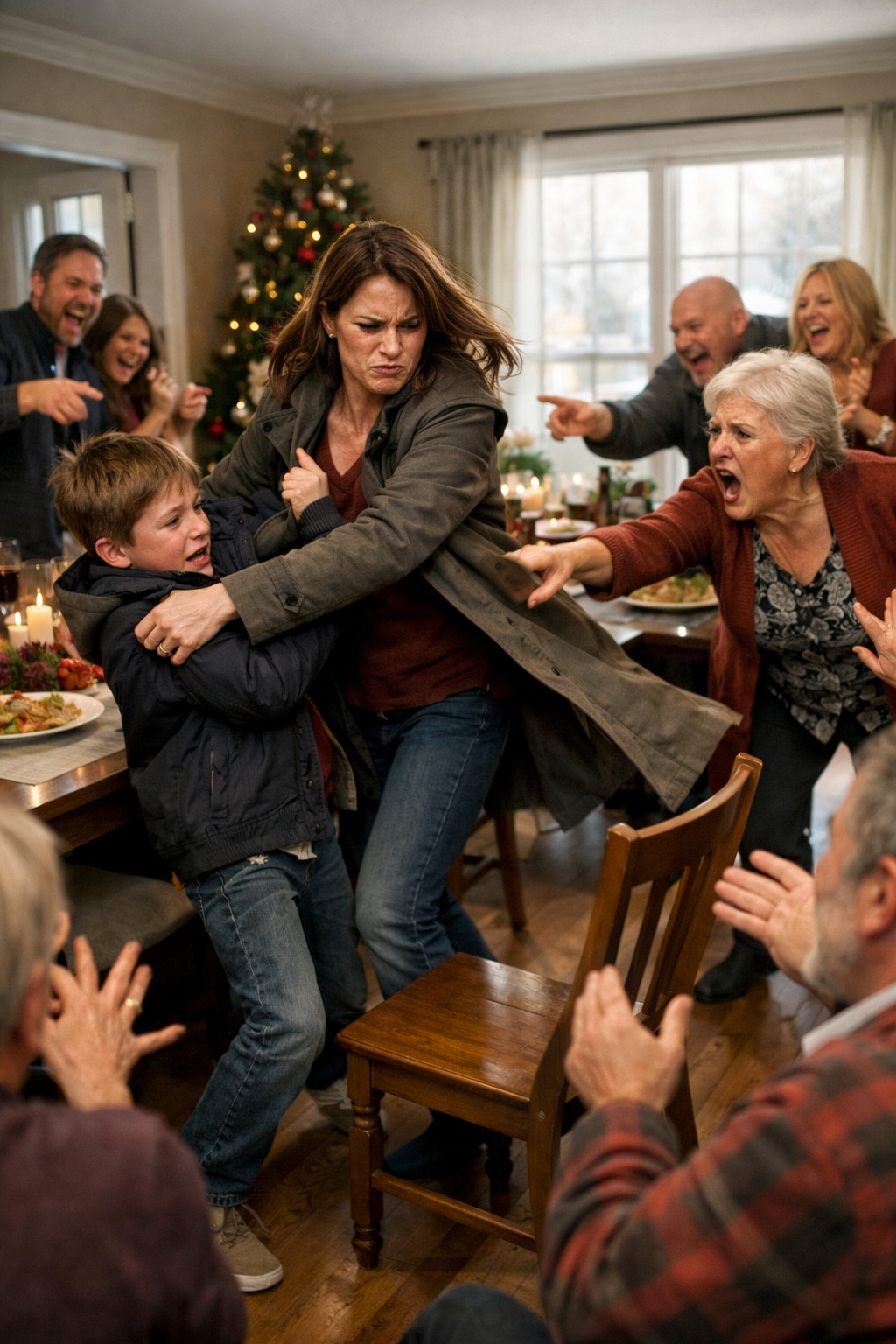

Part 2
The next morning, my phone vibrated so hard it nearly knocked itself off my nightstand.
I didn’t reach for it immediately. I lay there staring at the ceiling, listening to the faint hum of the heater and the softer sound of Noah breathing down the hall. My body felt strangely light, as if I’d been carrying a weight for years and someone had finally cut the straps.
The buzzing kept going. Missed calls stacked up. Messages poured in. My mother. My father. My sister. Even my aunt, which meant the narrative had already been distributed.
I got up, made breakfast, and cut Noah’s toast into triangles because that’s how he liked it. He ate slowly, watching me the way kids do when they sense emotional weather changing.
“Are we still bad at Grandma’s?” he asked.
It hit me so hard I had to set the butter knife down.
“No,” I said, crouching to meet his eyes. “We’re just not going places where people are mean to us anymore.”
Noah considered that, then nodded like it made perfect sense. Kids accept boundaries faster than adults because they haven’t been trained to confuse suffering with love.
After he got on the school bus, I finally picked up my phone.
The first voicemail was my mother. Her voice was trembling—not the shaky kind, but the theatrical kind, where each breath sounded rehearsed.
“I don’t understand why you would do this on Christmas,” she said. “You humiliated me in front of everyone.”
Humiliated her. The woman who slapped my son and publicly declared him unworthy of a cookie.
The next voicemail was my father, his voice clipped and sharp. “What does pulling out mean? This isn’t funny. Call me.”
Then texts from Leah.
You always do this.
It was a joke.
You’re really going to blow everything up over a cookie?
Isn’t it amazing how cruelty becomes small the moment it has consequences?
I didn’t respond to Leah. I responded to my father with one sentence.
It means I’m no longer paying the business loan. Effective immediately.
The typing dots appeared almost instantly. Then disappeared. Then my phone rang.
I answered and put it on speaker. “Hello.”
My father’s voice exploded through the kitchen. “Are you out of your mind? You can’t decide something like this overnight.”
“Overnight,” I repeated, calm. “Like it hasn’t been building for years?”
“We need that payment,” he snapped. “Contracts depend on it.”
My mother grabbed the phone, and I could hear the movement, the quick intake of breath like she was preparing for a performance.
“You are being incredibly cruel,” she said. “After everything we’ve done for you.”
There it was. The sentence engraved into my childhood. After everything we’ve done for you.
As if love was a bill.
As if they’d provided care out of generosity instead of responsibility.
“I’m not being cruel,” I said. “I’m being finished.”
My mother’s voice sharpened. “Oh please. You’re twisting things. He needs to learn. Not everything is for him.”
I closed my eyes. “He learned something,” I said. “Just not what you think.”
Silence. Heavy and thick.
Then my father again, lower now, controlled. “Do you have any idea what this could do to the business?”
That’s when I understood. They weren’t calling because they felt guilty. They weren’t calling because they missed Noah. They were calling because they were scared.
My role in the family had never been daughter. It had been backup plan.
“I’ll think about it,” I said, and hung up.
Not because I needed time.
Because for once, they did.
An hour later, a message came from my grandmother—my dad’s mother, the woman who always slipped Noah extra cookies and whispered, Don’t tell your mom.
I heard what happened. You did the right thing. I wish I had your courage years ago.
My eyes blurred. I cried at the kitchen table, not because I regretted leaving, but because a single quiet sentence from the only gentle adult in that family made me feel more supported than I had in decades.
By evening, the messages shifted tone. Less rage. More bargaining.
Leah asked if I could at least help until spring. My father sent spreadsheets like numbers could guilt me into compliance. My mother sent a long paragraph about family loyalty and how fragile your father’s health has been lately.
Concern only appeared when money disappeared.
Then, late that night, Leah called. Her voice sounded thin and nervous.
“I need to tell you something,” she said quickly. “Before you hear it from someone else.”
I stared at the living room Christmas tree, its lights blinking slowly, like it was trying to keep time with my heartbeat. “What?”
She exhaled. “Dad’s been lying to you.”
My stomach dropped.
“The business isn’t just struggling,” Leah said. “It’s… it’s sinking. And the loan you’ve been paying? It’s not going where you think.”
I sat down hard on the couch.
“It’s been covering Kyle,” she whispered.
Kyle. My older brother. The golden child. The one who never paid for his mistakes.
“What do you mean covering him?” I asked, already knowing, because the puzzle pieces had always been there, just never assembled.
Leah’s voice cracked. “Gambling. Debts. Some failed… ventures. Dad’s been using your payments to plug holes. To bail him out. Quietly.”
I felt rage rise so clean and sharp it almost felt like clarity. My money. My sacrifice. My compliance. All of it redirected to protect the one they called “good.”
“Why didn’t you tell me?” I asked.
“I didn’t know,” she said. “Not until last week. I overheard Mom yelling at Dad about it. And I…” Her voice broke. “I hate myself. Because when Mom hit Noah’s hand, I didn’t stop her.”
I didn’t comfort her. Not then. My compassion was reserved for the child whose small hands had been slapped away.
That night, after Noah was asleep, my phone lit up again.
A text from my father.
I failed you. I should have protected you. Please don’t let everything collapse.
It was the first time he’d ever admitted fault without attaching an excuse.
I stared at it for a long time.
I wasn’t planning to burn everything down.
But I was done saving them by sacrificing myself.
Meet me in person, I typed. On my terms.
I sent it and set the phone down.
For once, I wasn’t reacting.
I was deciding.
