
Part 2
I had just tamped the last scoop of dirt around the signpost when I heard it: the staccato click of expensive sneakers on pavement, followed by a voice already set to maximum volume.
“What do you think you’re doing?”
I turned around, wiping my hands on my jeans.
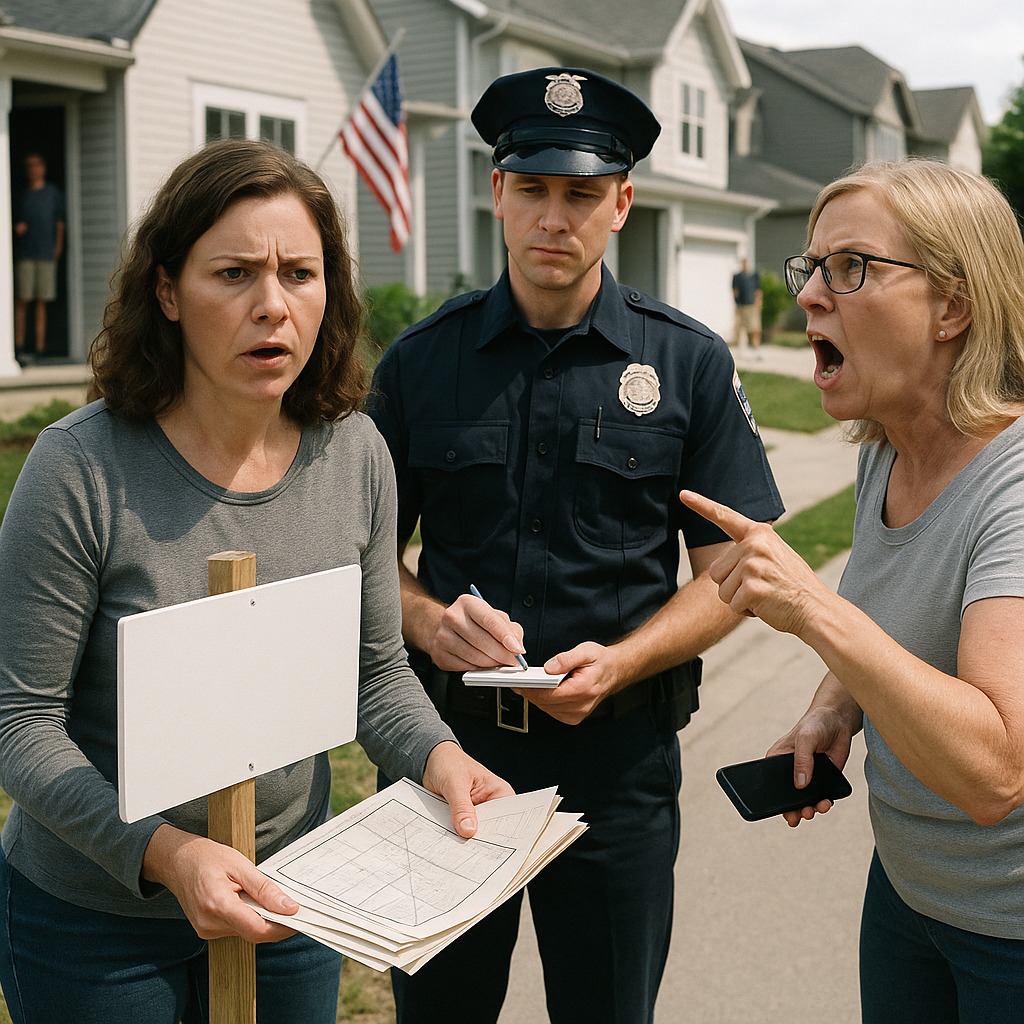
Karen stood at the edge of the gravel, phone already in her hand, face red in that particular shade of offended belonging only to people who genuinely believe rules are for other people.
She was in her usual uniform: pastel athletic top, matching leggings, visor, sunglasses perched on her head like a crown. Her little HOA badge—yes, she actually wore one—clipped to her waistband.
“I’m putting up a sign,” I said. “On my property.”
She snorted. “No, you’re not. That ‘property’ is HOA controlled. You can’t just stick signs wherever you feel like.”
She lifted her phone to her ear, even as she kept glaring at me. “Hello? Yes, I want to report a trespasser. He’s putting up illegal signage on community land and refusing to leave.”
The words trespasser and illegal hung in the air, heavier than they should have. I felt my jaw tighten.
“Karen,” I said steadily, “you might want to hang up. You’re making a big mistake.”
She turned away from me, pacing a small, angry circle. “Yes, 911, it’s an emergency,” she insisted. “He’s aggressive. He’s trying to block our common access road.”
Aggressive.
I hadn’t moved. I hadn’t raised my voice. I was standing next to a signpost with a shovel in my hand like any other homeowner finishing a Saturday chore.
But I’d seen enough news stories to know how fast that word could spin out of my control.
I slid the shovel into the dirt, palms open, voice calm.
“Karen, you’re on camera,” I said.
She scoffed. “What are you talking about?”
I tilted my head toward the small shed at the corner of my yard. Just under the eaves, a black camera lens stared back at us, the tiny red light blinking steadily.
New system. Installed last week on the advice of someone who knew her favorite hobby.
Because here’s the thing about small-town cops: they’ll never say it on paper, but they know exactly who their frequent flyers are. And over the past few months, every time I’d passed a patrol car on my way in or out of the subdivision, Officer Davis had rolled down his window and said some version of the same thing.
“Watch out for your HOA VP, Hayes. She likes to call us for sport.”
On the phone, Karen was ramping up the performance. “He’s refusing to leave,” she practically gasped. “He’s threatening my safety. Yes, I feel unsafe. Yes, I want to press charges.”
I felt a cold anger settle under my ribs. Not the hot kind that makes you say something stupid. The slow kind. The kind that waits.
“Every word, Karen,” I said quietly. “Every word is being recorded. Video. Audio. Time-stamped.”
For a split second, a flicker of doubt crossed her face. Then she doubled down.
“I don’t care,” she snapped, hanging up. “The cops always take my side. You’ll be gone in ten minutes.”
“Sure,” I said. “We’ll see.”
She folded her arms, tapping one foot, staring at the sign like it was personally insulting her. My kids were watching from the back porch, eyes wide. Jenna stood behind the sliding glass, phone in her hand, our prearranged signal glinting in the reflection: I’m here. I’m watching. I’m ready.
We didn’t have to wait long. The familiar blue-and-white cruiser rounded the corner at a respectful speed, lights off, no siren. This wasn’t the city; we still had the illusion of quiet here.
Karen’s entire body language changed. Chin up. Shoulders back. Concerned citizen mode engaged.
“Officers, over here!” she called, waving her arms like she was hailing a lifeboat. “He’s right here!”
Two officers stepped out. Davis, mid-forties, eyes lined from years of dealing with other people’s bad decisions. Next to him, a younger guy I didn’t know, face still a little too open for this job.
Davis glanced at me, gave the smallest of nods. The rookie looked between me and Karen, clearly unsure who the bad guy was supposed to be.
Karen rushed them like she’d been practicing for this moment in front of a mirror.
“I need him removed,” she snapped, pointing at me. “He’s violating HOA ordinances, trespassing on common land, and when I asked him to leave, he got aggressive. This is supposed to be a safe neighborhood.”
“Ma’am,” Davis said, hand up, “let’s slow down and take this one step at a time.”
She huffed, but lowered her volume a notch. “Fine. But I expect you to do something. This is how problems start.”
She gestured at the sign like it was a live grenade.
Davis turned to me. “Afternoon, Hayes. Want to tell me what’s going on?”
“Sure,” I said. “But before we get into he-said-she-said, there are a couple of things you should see.”
Karen scoffed. “He’s lying. He’s been out here all morning, causing trouble.”
Davis’s gaze flicked from her to me. “You got proof?” he asked.
“Oh, I’ve got proof,” I said.
I pointed toward the shed. “First, that camera? It’s been recording since before she walked up. Audio, video, the whole performance. Second, that orange stake behind her heel? That’s the official property marker the county surveyor put in last week.”
Karen turned around, startled enough to actually move her foot. There, half-hidden in the grass, was the bright plastic of the stake, its metal tag glinting.
She tried to recover fast. “That marker isn’t real,” she snapped. “Someone probably stuck it there. I’ve lived here eleven years. I know exactly where the HOA line is.”
The rookie shifted his weight, uncertain. That was Karen’s favorite space: the gray area between confidence and doubt.
Davis stepped around her, bent down, and flicked the tag with his finger. “County seal,” he said. “These don’t just pop up on their own, ma’am.”
Karen’s jaw tightened. “Well, it’s wrong.”
“Maybe,” Davis said easily. “Good news is, that’s not for us to decide.”
I walked over to my truck, ignoring her muttered, “Yeah, run away,” and pulled out the black folder I’d put on the passenger seat that morning.
Just in case.
I flipped it open as I walked back, letting the crisp, official paper catch the sunlight.
“This,” I said, handing the first document to Davis, “is the deed transfer for parcel 17-B. Signed by the county, recorded three weeks ago. And this—” I slid another sheet free and held it out— “is the county map showing that parcel as no longer county surplus, but privately owned.”
By me.
Davis read faster than I thought he would. His eyebrows rose.
“Ma’am,” he said, turning the papers so Karen could see the black-and-white lines, the official stamp, my name, “as of three weeks ago, this land is his. Not the HOA’s. Not the county’s. His.”
She stared like the words were written in another language.
“That’s not possible,” she said weakly. “The HOA president would’ve told me. I’m on the board. You can’t just–just buy our land out from under us.”
“I didn’t buy your land,” I said. “I bought land your board never legally owned.”
“That’s not what Rick said,” she shot back. “He told us the developer dedicated this strip as common access. That’s how it’s always been.”
“Then Rick can take it up with the county,” I said. “Because they’re the ones who sold it to me.”
Color rose in her face. “You’re lying. You must have tricked someone. This is fraud.”
I slid out the third document from the folder. It was thicker. More pages. More signatures.
“And this,” I said, “is the county’s preliminary audit of your HOA. Crossed wires on property lines. Fines issued on land you don’t own. Mismatched budget entries. It’s all in here. Funny how the county investigator seemed very interested when I mentioned you’d been handing out violations for standing on a strip that wasn’t yours.”
Davis let out a low whistle. The rookie leaned in, eyes wide.
“Ma’am,” Davis said, voice now edged with something colder, “you didn’t mention you were on the board under investigation.”
Karen blinked. “Under what?”
“Last month?” I said. “When a group of us filed complaints about bogus fines? Spending that doesn’t match dues collected? You might want to attend the next county oversight meeting, Karen. Your name is all over the reports.”
Her composure cracked. Just a hairline fracture, but enough.
“That has nothing to do with this,” she stammered. “He put up an illegal sign.”
“On his land,” Davis said. “That you told us was common. After calling 911 and saying he was threatening you.”
“He was!” she insisted. “He–he looked aggressive.”
“I didn’t move,” I said. “I didn’t yell. And we have the recording to prove it.”
Davis looked at me. “Your system records audio too?”
“It does,” I said. “Backed up to the cloud.”
He nodded, making a mental note.
“Okay,” he said, stepping back so he could see both of us. “Here’s where we are: We have a legal deed showing this strip belongs to Hayes. We have a survey marker backing that up. We have a caller who claimed he was trespassing and threatening her when the opposite appears to be true.”
Karen’s eyes went wide. “Are you–are you accusing me of something?”
“I’m saying,” Davis replied, “that filing a false police report is a crime in this county. And interfering with someone’s lawful use of their property is another issue entirely.”
She sputtered. “I…didn’t know. I thought—”
“That’s the problem,” I said quietly. “You never think. You just assume.”
For the first time since I’d known her, she had no comeback ready.
Silence settled over the cul-de-sac, broken only by the soft whirr of the camera on my shed, recording every second.
And we weren’t even done yet.
