
Part 3
The call came at 8:07 a.m. on a Tuesday.
I remember the exact time because I glanced at the clock while stacking gum at the front register, thinking about how this was usually when the morning rush faded into a lull. The air inside the store was cool against the rising heat outside. The hum of refrigerators, the soft beep of the scanner, the low murmur of customers—all the familiar noises of my days.
Then Greg’s office door flew open like someone had kicked it.
He came out gripping his phone so tightly his knuckles were white. His face had gone that dark, blotchy red I’d only seen twice before—both times when inspectors showed up unannounced.
His eyes swept the store, wild, unfocused, as if the problem might be hiding behind the coffee filters.
“Tessa!” he shouted. “Where is she?”
She popped up from behind the counter, where she’d been filming a “behind the scenes” clip of herself pretending to restock candy.
“What?” she said, her smile already half-formed for the camera. “God, Dad, chill. You’re gonna scare the customers.”
“Turn that thing off,” he snapped.
The phone slipped in her hand. The smile fell from her face, dropped to the floor, shattered.
“What happened?” she asked, voice suddenly small.
He didn’t answer her. Not directly.
He turned to me instead.
“Did you know about this?” he demanded. “Did anyone—? How did this—?”
He waved the phone in the air like a weapon. I could hear a voice bleeding out from the speaker. Angry. Professional. Relentless.
“I have no idea what ‘this’ is,” I said. “You’re going to have to use actual nouns.”
His jaw clenched. For once, he didn’t have a metaphor.
“A vendor went over my head,” he spit out. “Straight to corporate. Missing inventory. Unpaid invoices. They’re accusing us of negligence and fraud.”
The word fraud landed with a dull thud.
I thought of the vendor pacing outside the loading dock. The one Tessa had called “dramatic” before ignoring his emails. The one whose envelopes had been used as coasters.
“I see,” I said.
The voice on the phone was still talking. I recognized the cadence of corporate outrage. It was different from Greg’s—less flailing, more focused.
“How could this happen?” he muttered, half to himself, half to the ceiling. “We’ve been solid for years. Years. And now suddenly—”
I waited for him to finish the sentence.
He didn’t.
He lunged for the stock room, calling for Tessa again. She followed, heels clacking against the tile.
The customers in the aisles pretended not to watch. People always pretend not to enjoy a train wreck. They move their eyes instead of their heads, but the effect is the same.
I took my time finishing the gum display, then walked toward the back. Not too close. Just near enough.
The office door was open.
“This is ridiculous,” Tessa was saying, voice high and strained. “They’re like, making a big deal out of nothing. Vendors always screw up. Why are they acting like this is on us?”
Greg slammed the office computer awake. The emails popped up on the screen like bullet holes.
The first one. The polite one. The second. The pointed one. The third—highlighted, bold, with the subject line: Immediate action required.
He hadn’t replied to any of them.
He clicked open the attached report. The numbers glared back at him. Inventory missing. Orders unaccounted for. Invoices past due.
“Where are the logs?” he demanded. “The delivery slips, the night reports, the temp charts—where is everything?”
Tessa went pale.
“I—I did some of them,” she said. “I mean, I was going to go back and fill in the rest, but it’s been crazy and—”
“Where?” he shouted. “Where, Tessa?”
She opened drawers at random, shuffling through piles of coupons, broken pens, crumpled sticky notes, half-open packages of merch she’d meant to “feature” in a video.
No logs. No slips. No reports.
Just clutter.
“I thought you were on top of this,” he said. “You told me you were.”
“I am!” she protested. “I mean, I have been. It’s just—there’s a lot. You never told me it was this complicated. You said Karen did all this stuff like, in her sleep.”
Both of their heads turned toward me.
For fifteen years, this had been my moment to step in. To say, “It’s okay, I’ve got it.” To pull the right paper from the right folder. To click the right buttons. To save them from the mess they’d created.
This time, I just raised an eyebrow.
“You want me to jump in?” I asked.
“Yes!” Tessa blurted. “Obviously!”
Greg hesitated.
The hesitation was small. A flicker of pride, of panic, of something ugly.
This is your chance, some part of him thought. To prove she’s still needed. And my chance to prove I wasn’t wrong.
“I already told corporate you have everything under control,” he said instead. “You said you did. You told me you did.”
Her mouth opened and closed soundlessly. The phone in her hand vibrated with notifications she didn’t check.
The office phone rang again.
Greg grabbed it like a lifeline, his voice shrinking lower and lower as whoever was on the other end dismantled whatever defenses he’d tried to build.
“Yes, I hear you,” he said. “Yes, I understand. Of course. We’ll… we’ll have everything ready for you.”
He hung up, then stared at the receiver like it had betrayed him.
“They’re sending someone,” he said. “From corporate. Today.”
The word today made the room contract.
He spun around to the two cashiers who’d been watching from the doorway, eyes wide.
“Have any of you been messing with the numbers?” he barked. “Taking product? Forgetting to ring things up? Because someone is sabotaging this store.”
Their faces registered the accusation like a slap.
“No, sir,” one of them said. “I swear. I do everything by the book. Karen taught me how.”
He threw my name into the air like a wrench.
Greg’s gaze snapped back to me again.
A year ago, he would have jumped at the opportunity to make this my problem.
Now he couldn’t.
Not without admitting that he’d taken the wheel away from me and handed it to someone who’d used it as a selfie stick.
“Corporate wants the last ten days of night reports,” he said. “All of them. Printed out. And the security footage. All the deliveries. All the closings. They’re going to ‘review our processes.’”
The air quotes didn’t make it sound softer.
Tessa’s eyes were shiny. “I can redo the reports from memory,” she said quickly. “I totally can. I remember most nights.”
“From memory?” I repeated before I could stop myself.
She rounded on me.
“What?” she snapped. “You think I can’t?”
“I think numbers are not a vibe,” I said. “They’re numbers.”
Her lip trembled. She blinked hard, smearing the edge of her mascara.
“I’ll do it,” she insisted. “I’ll fix it.”
She wouldn’t. She couldn’t. The system didn’t care about good intentions or curated filters. It cared about math.
I stepped back, my shoulder resting lightly against the doorframe.
For the first time, I watched my boss search desperately for someone to blame and find the circle of suspects tightening around him.
He’d built this world on the assumption that loyalty flowed only one way: toward him. That his years of taking me for granted would somehow buy him protection when the wolves came sniffing.
The wolves, it turned out, had clipboards and neutral expressions.
They arrived just after lunch.
You can always tell who’s from corporate. They have a posture—a certain clipped efficiency in their stride. They walk through your space like they already know how the story ends and they’re just there to fill in the paperwork.
Two suits. One regional manager I’d seen only twice in person but many times in training videos. They didn’t browse the shelves or comment on the new display. They walked straight to the office like they had a GPS coordinate set for Greg’s ego.
He hurried forward with a smile that wobbled at the edges.
“Hey there!” he said. “Wish we had more notice. I would’ve—”
“We gave you three emails’ notice,” the older suit said. His voice was calm. That was the thing about the really dangerous ones. They never needed to raise it.
The regional manager—her name was Denise, I remembered suddenly—held a tablet and a folder. Her gaze took in the front counter, the still-open safe in the background of the security monitor, the sticky note stuck to the computer that read “remember to do logs!!!” in Tessa’s loopy handwriting.
They closed the office door halfway.
Not fully.
Halfway was worse.
It meant everyone could hear enough to understand without being able to pretend they weren’t listening.
The voices were low but sharp. Words floated out like knives.
“Variance.”
“Liability.”
“Pattern.”
“Two weeks.”
I stocked shelves. I wiped down counters that were already clean. I moved slower than I needed to so I’d still be standing there when the door opened.
When it did, Denise stepped out first.
Her eyes went straight to the security monitor mounted near the office. “Who has admin access to the footage?” she asked.
Greg cleared his throat. “Well, I—uh—I do, technically, but the system is kind of finicky and—”
“And?” she prompted.
“And Karen usually handles it,” he finished, grudgingly.
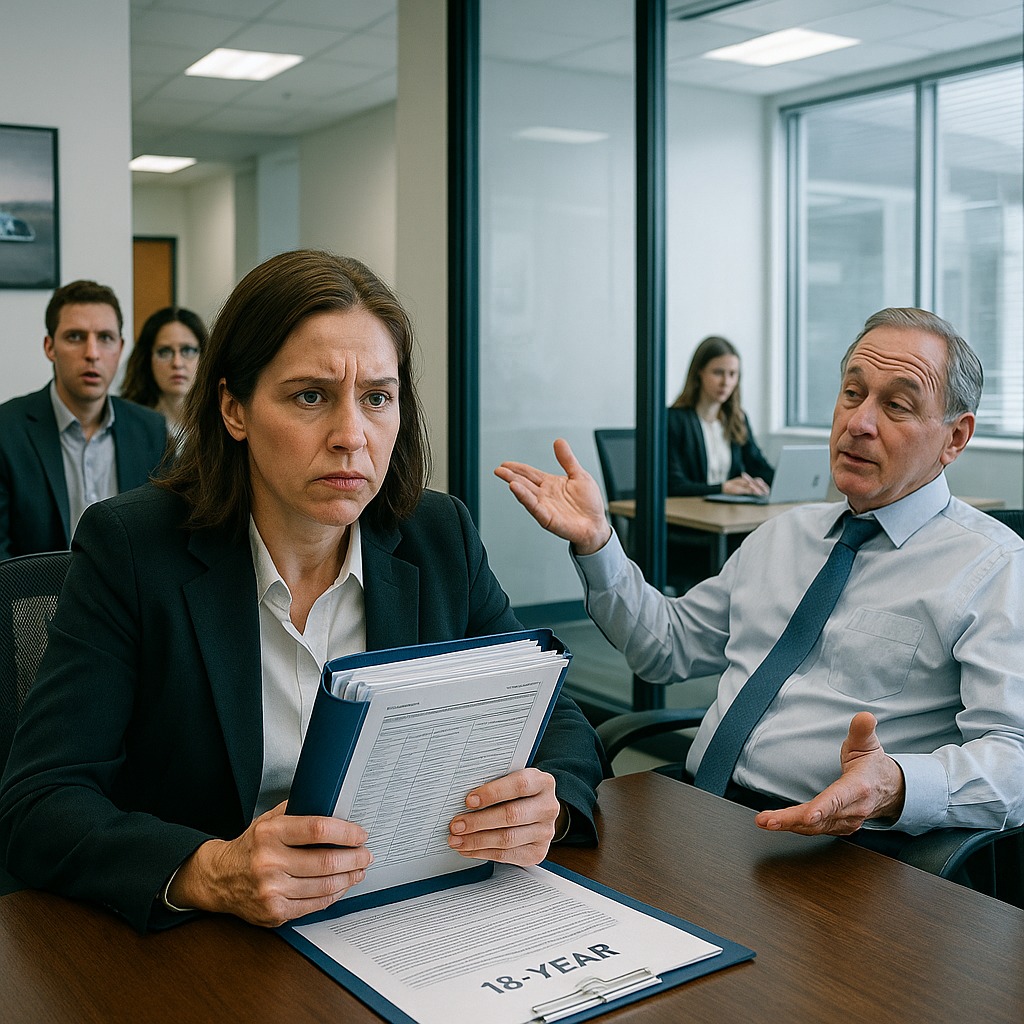
Their heads turned.
It was strange, suddenly being the center of the frame.
“Can you pull up the last ten days of closing footage?” she asked me.
“Yes,” I said.
Greg started to move toward the monitor. “I can show her—”
“It’s okay,” Denise said. “Let her.”
I walked to the panel, typed in the password, and navigated through the menus by muscle memory. Fifteen years of invisible work distilled into a few practiced keystrokes.
The footage appeared.
Night after night. Time stamps glowing in the corner. The empty store, the closing routines—what was supposed to be the closing routines.
They watched Tessa skip steps. They watched her leave early and hand the keys to whoever happened to be closest. They watched her prop the door open to film outside and then forget to lock it for twenty minutes. They watched a delivery come in and be signed for without anyone scanning, counting, or logging the product.
They watched money walk out the door.
No one spoke for a long time.
Finally, the younger suit asked, “Who is this?” even though they already knew.
“My daughter,” Greg said, his voice paper-thin.
“And who put her in charge of closing procedures, inventory verification, and vendor relations?” Denise asked, not looking away from the screen.
“I did,” he said.
“And who overrode the system’s training requirements to bypass the standard certification?” she pressed.
His cheeks mottled. “It’s my store,” he said weakly. “I should be able to make personnel decisions.”
She tapped her tablet. “It’s the company’s store,” she corrected. “You manage it. Or rather, you were supposed to.”
Tessa stood behind the counter, shoulders hunched, mascara streaking down her cheeks. Her phone sat face-down for once. She looked like a kid who’d stayed at the grown-up table too long and was just now realizing the conversation wasn’t about dessert.
The suits asked practical questions.
Who used to handle these tasks?
“How long have you been with us, Karen?” Denise asked.
“Fifteen years,” I said.
“And during that time, have we ever had this kind of variance?”
“No,” I said. “Not once.”
“Who did night reports, temperature logs, and inventory checks before the recent change?” she asked.
“I did,” I said.
I didn’t add that I’d done them quietly, on my own time, while Greg bragged about “his” low shrink numbers.
They could connect that dot themselves.
Greg tried one last time to throw sand on the flames.
“The systems are outdated,” he said. “It’s confusing. The vendor must have miscounted. The staff is still adjusting to change.”
Every excuse he offered built a higher wall around the truth, trapping him inside.
Denise listened patiently, then brought up the financials.
The graphs were brutal.
A flat, steady line for fifteen years. Then, in the last two weeks, jagged spikes and drops. Losses. Waste. Shortages.
All of it starting the week he told me I was training wheels in an F1 race.
“The store has been stable for a decade and a half,” Denise said evenly. “And unstable for fourteen days. This is not a mystery.”
He wilted.
I had never seen Greg look small before. Not once in fifteen years. Even when he’d been wrong, he’d been confidently wrong. Now his shoulders slumped, his eyes glistening with the dawning understanding that his name was the one on the line, not just his daughter’s.
“What happens now?” he asked.
Denise’s answer was simple.
“We restructure,” she said.
The suits went back into the office with him and closed the door fully this time.
When they emerged ten minutes later, Greg’s face was blotchy and stunned. Tessa’s was wet and blotchy and furious.
Corporate didn’t raise their voices. They didn’t need to. Termination, when done by professionals, doesn’t require volume.
They walked the two of them to the side door.
For the first time in fifteen years, Greg left the building without reminding me to check the coffee filters, to lock the back door, to “hold down the fort.”
He didn’t say anything at all.
The door shut softly behind them.
The suits came back to the office. Denise gestured for me to follow.
The room felt different with him gone. Bigger, in a way. Airier. The same mismatched furniture, the same outdated posters about safety and upselling. But the weight in the center had shifted.
“Karen,” she said, folding her hands. “Sit down.”
I did.
“How long,” she asked, “have you been doing more than your job description requires?”
I almost laughed.
“Uh,” I said. “I don’t know. Thirteen years?”
She nodded like that matched the number in her head.
“Do you understand vendor relationships, audits, ordering cycles, staff scheduling, and loss prevention protocol?” she asked.
“Yes,” I said. “I’ve been handling those informally for a while.”
“Do you want to?” she asked.
I blinked.
Did I want to be responsible for the thing I’d already been quietly carrying? Did I want the recognition, the title, the salary that should have come with the nights and weekends and worry lines?
“Yes,” I heard myself say.
She smiled. It was small, but it reached her eyes.
“Good,” she said. “Because the store needs a manager who actually knows how to run it. We prefer to promote from within when possible. The position is open. It’s yours, if you want it.”
For a moment, my mind flashed to the first day I walked into this place at eighteen, thinking it would be a temporary job while I figured my life out. To the years of being “just” the shift lead. To the training wheels line. To my daughter’s face at the kitchen table.
“Yes,” I said again. This time it came out stronger. “I want it.”
The word settled in the room, solid.
She nodded. “We’ll adjust your pay and benefits accordingly. There will be paperwork, of course. Training modules. A few hoops. But functionally, you can start now.”
“Now?” I repeated.
“Yes,” she said, standing. “The store still has customers. It still has bills. It still has employees who need a leader.”
She extended her hand.
“Congratulations, Karen,” she said. “You’ve been running this place for a long time. It’s about time your name matched the work.”
Her hand was warm. The shake was firm.
Something unknotted in my chest, slowly. Like a rope that had been pulling in one direction for so long it forgot what slack felt like.
The rest of the day went on.
Customers came and went. Deliveries arrived. The coffee brewed. The lottery tickets printed.
But everything felt different, as if some invisible pressure had finally shifted off my shoulders and settled where it belonged—into a job description, into a pay raise, into the nameplate that would soon read Store Manager instead of pretending those responsibilities belonged to someone else.
That night, I closed the store as manager.
I walked the aisles with a different awareness, not because the tasks had changed, but because the story had.
I checked temp logs and filled them out myself, pen moving smooth and sure over the paper. I balanced the register, catching a miscount with the same easy flick of my finger I’d always had. I turned off the lights, one by one.
At the front door, I paused.
For fifteen years, I’d locked this door and gone home feeling like I’d left a piece of myself inside, unpaid and unacknowledged. Like some part of my value was trapped in a building that would never fully see it.
This time, when the key turned and the lock clicked, something else clicked with it.
Not triumph.
Not revenge.
Just… release.
