
Part 3
Weeks passed.
The world around me shifted from end-of-year chaos to sticky summer calm. Campus emptied. Ava moved back to her parents’ place for a while, promising to visit. My favorite coffee shop transitioned from exam-fueled insanity to lazy tourists wandering in with maps and bad questions.
My phone, which had once been a pipeline for my family’s demands, went quiet.
No calls from Mom asking if I could cover “just this one bill.” No voicemails from Dad reminding me about Lily’s performances, fundraisers, events I was expected to attend and pay for. No texts from my sister asking if I could Venmo her “just until Friday.”
The silence was almost loud.
Cousin Mia was the only one who broke ranks.
She called three days after The Airport Incident, her voice tentative.
“So,” she started, “I heard there was some… drama.”
“Depends on who you ask,” I replied, sitting cross-legged on the floor of my new studio. The couch hadn’t arrived yet. My mattress was still propped against the wall. The only furniture I had was the thrifted desk and a folding chair I’d rescued from a curb.
“They canceled the trip,” Mia said. “Your mom is telling everyone that the airline screwed them over and wouldn’t honor the tickets. But Aunt Rosa and I were sitting right there when the story popped up. That timing was… suspicious.”
“Is that your gentle way of asking if I did it?” I asked.
“I mean…” She hesitated. “Did you?”
“Yeah,” I said. “I did.”
She let out a low whistle. “Damn, Em. That’s… big.”
“So was the balance,” I said dryly.
There was a pause. I could almost hear her weighing loyalty against honesty.
“For what it’s worth,” she said finally, “I think they had it coming.”
The words hit me harder than I expected. Until that moment, everyone involved in the situation had either been blood or strangers. Hearing someone in the gray area between—a cousin who’d spent years as my sister’s second-tier shadow at family events—say that was like having someone turn a light on in a dark room.
“You do?” I asked.
“Your mom has been using you like an ATM since we were fifteen,” Mia said bluntly. “Every time you got a job, some new emergency popped up. Meanwhile, Lily gets a new phone every time she cries about ‘content quality.’”
“It wasn’t always that bad,” I said automatically, out of reflex more than belief.
Mia snorted. “Remember when your grandma left you that savings bond because you were the only one who visited her in the nursing home, and your mom cashed it ‘for bills’ and then took Lily to that acting camp anyway?”
My throat tightened. I’d forgotten about that. Or maybe I’d filed it under “things we don’t think about if we want to function.”
“Yeah,” I said. “I remember.”
“I’m not saying I would’ve crashed her dream vacation,” Mia said. “But… I get it. And if it makes you feel better, she’s still posting as if she’s in Italy. She’s just using old Pinterest photos and pretending she’s there.”
“She’s faking it?” I asked, eyebrows lifting.
“Oh yeah,” Mia laughed. “Full-on, ‘living my best life in Rome!’ Meanwhile I saw her at the mall yesterday.”
A laugh burst out of me, sharp and unexpected.
“That’s… of course she is,” I said. “Her pride would never survive admitting her trip got canceled.”
“Well,” Mia said, “if you ever want to actually go to Italy, I hear they let people who pay for their own tickets on the plane.”
After we hung up, I stared at the crack in the ceiling for a long time.
I hadn’t thought much beyond the act itself. Withdraw. Stabilize my own life. Build something.
Now, small possibilities started to sprout in the cracks my family’s absence left behind.
I found a job two weeks later, at a mid-sized marketing firm downtown. My degree wasn’t glamorous—Business Administration with a minor in data analytics—but apparently, knowing how to read spreadsheets and not freak out in front of clients was valuable.
The salary wasn’t huge, but it was more money, consistently, than I’d ever had at once. It came with benefits, too—health insurance that wasn’t tethered to my parents, and a 401(k) I stared at blankly while HR explained matching percentages.
On my first day, I wore the only decent blazer I owned and carried a thrifted leather bag Ava had given me as a graduation gift.
The office smelled like coffee and printer ink. People milled around in business-casual outfits, juggling laptops and iced lattes. My supervisor, a woman named Claire in her thirties with sharp eyeliner and sharper wit, shook my hand.
“Emma, right?” she said. “We’re glad to have you. I’ve read your portfolio. You’re the first intern who actually seems to know how to build a budget that doesn’t look like a toddler scribbled on Excel.”
“High praise,” I said. “Toddlers are surprisingly good with patterns.”
She laughed. “You’ll fit in fine.”
At lunch, when everyone else took calls from spouses and parents and group chats, I sat on a bench outside with my sandwich and my phone, scrolling through the familiar faces on social media.
My mother’s account was quiet. No Italy content, obviously. She’d posted a throwback photo of Lily from her first ballet recital with a caption about “watching her grow into the woman she was always meant to be.”
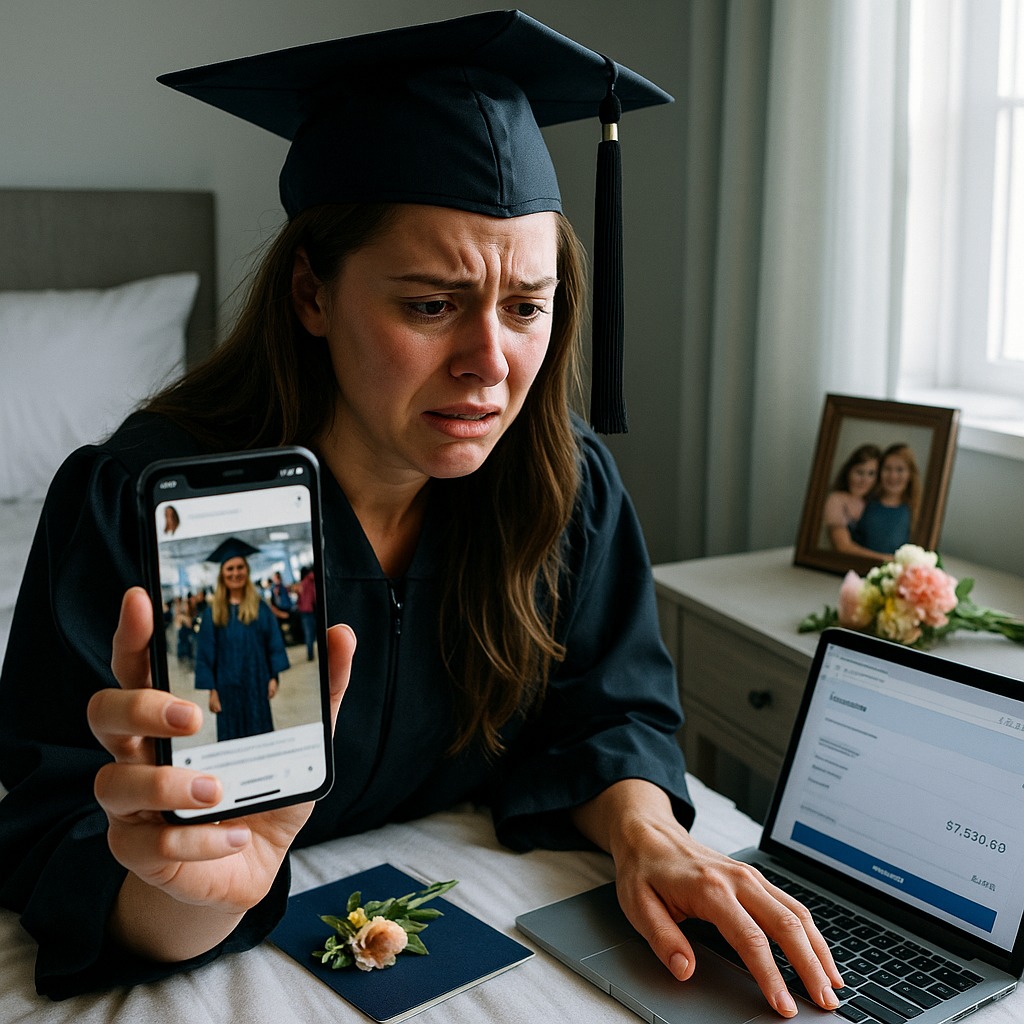
My graduation day still wasn’t mentioned.
My father’s Facebook had a screenshot of a meme about “ungrateful kids these days” layered over a picture of a boomer shaking his fist at the sky.
Lily’s Instagram, as Mia had promised, was a masterpiece of fiction. Photos of gelato cups, cobbled streets, sweeping city views—all neatly credited “Rome, Italy” and “Florence, Italy” with captions like, “Ciao bella!” and “So obsessed with this place.”
I recognized half of them from travel bloggers I’d followed for years.
The comments were full of heart emojis and envy.
“So happy for you!”
“Living the dream!!”
“Your parents are GOALS.”
I locked my phone and finished my sandwich.
That night, when the workday was done and my apartment was still more echoing space than home, I held my own private graduation.
I spread my diploma, my employment contract, and the printout of my bank balance on the countertop and looked at them all together.
Four years ago, I’d walked into my parents’ kitchen and signed my name onto a joint account “for emergencies.” I’d believed them when they said we were a team.
Now, I had my own account, my own lease, my own income. My own emergency plan.
Some families teach you love. Mine taught me strategy.
I was done apologizing for using the tools they’d handed me.
Still, trauma leaves splinters.
A week later, my phone rang while I was in the grocery store, comparing prices on pasta sauces like a real adult.
Dad.
The name flashed on the screen, familiar and foreign at the same time. I stared at it for two rings, thumb hovering over “Decline.”
On the third ring, I swiped “Answer.”
“Hello?”
He didn’t say hi.
“What the hell did you do?” he barked.
Hello to you too, I thought.
“Hi, Dad,” I said instead. “I’m great. Thanks for asking.”
“This isn’t funny, Emma,” he snapped. “Your mother is beside herself. Your sister is devastated. You humiliated us.”
I picked up a jar of sauce, checking the label. “How did I humiliate you?” I asked. “By using my legal right to access money I earned?”
“Don’t get smart with me,” he growled. “We had an understanding. That account was for the family.”
“I am family,” I said. “At least, I thought I was.”
“You still are,” he said. “Act like it. You embarrassed your mother in public. Do you know how she felt, standing at that counter with the card declined? She’s never been so ashamed.”
The image should have satisfied some vindictive part of me. It didn’t. It just made my stomach twist.
“A tiny fraction of how I felt,” I said, “sitting at my own graduation while my family celebrated someone else at an airport.”
He inhaled sharply. “This again,” he muttered. “You’re jealous. You’ve always been jealous of—”
“Don’t,” I said. My voice came out sharper than I intended. A woman browsing cereal glanced over, then quickly looked away. “Don’t use that word like it explains everything. I’m not jealous that she got a trip. I’m angry that I paid for a life I wasn’t considered part of.”
“You’re twisting this,” he insisted. “We did our best by you. We kept a roof over your head; we gave you food—”
“You gave me a roof and food because that’s the bare minimum,” I interrupted. “I gave you thousands of dollars. I gave you my time, my work, my peace of mind. And in return, you gave me a comment on Instagram telling the world I don’t make you proud.”
There was a long pause.
“You always were dramatic,” he said finally, but the word lacked heat. “Your mother didn’t mean it the way it sounded.”
“How did she mean it, then?” I asked. “Walk me through the nuance of ‘she’s the only one who makes us proud.’”
He didn’t have an answer to that.
In the silence, I realized something: my father’s power over me had always been in his volume. In the way he could roar over any objection. But the phone equalized us. He could yell into the speaker all he wanted; I could still hit “End.”
“I’m hanging up now,” I said calmly. “We can talk again when you’re ready to speak to me like a person and not a disobedient employee.”
“Don’t you dare—” he started.
I pressed the red button.
My hand shook as I set the phone back in my cart, but only for a moment. Then the tremor passed, leaving something steadier behind.
I picked up my pasta sauce and moved on.
Boundaries, I was learning, don’t always feel empowering when you set them. Sometimes they feel like swallowing glass. But every time you do it, your throat gets a little tougher.
