
Part 4
Weeks passed in silence. No group chats. No dramatic emergencies. No voicemails soaked in guilt.
My mother never reached out. Not once.
No apology. No reflection. No attempt.
Her silence hurt, but it also answered every question I’d spent years asking.
My father surprised me. He didn’t beg. He didn’t bargain. He didn’t ask for money. Instead, he started calling every Sunday evening.
At first, the calls were awkward and short. He asked about Noah’s school projects. About my work. About my day. Real questions—ones he’d never bothered with before. Sometimes he would pause like he was searching for words he’d never practiced using.
One night, he said, “I don’t want to fix this fast. I want to fix it right.”
I didn’t answer immediately. Trust doesn’t return on a schedule.
A few days later, he asked if he could come over. Just him.
I hesitated, then looked at Noah at the kitchen table, carefully lining up his crayons by color, unaware of how close he’d come to learning that love was conditional.
“Yes,” I said. “But there are boundaries.”
When my father arrived, he didn’t bring spreadsheets. He didn’t bring excuses. He brought an envelope.
Inside was a handwritten letter with Noah’s name on it.
My father knelt down so they were eye to eye. His voice shook, but he didn’t look away.
“I’m sorry,” he said. “I laughed when I should have protected you. That was wrong. You didn’t deserve it. You’re a good kid. Always.”
Noah looked at me, checking my face like kids do when they need permission to trust. I nodded.
Noah’s voice was small but serious. “So I’m not a bad grandkid?”
My father swallowed hard. “No,” he said. “You never were.”
Noah paused, then asked the question that cracked something open in the room. “Can I have cookies now?”
My father blinked, then laughed—quietly, not at Noah, but with relief. “Yes,” he said. “You can have cookies.”
That moment didn’t erase the past. But it changed the future.
My father followed through. He sold part of the business. He paid off what he could. He stopped covering for Kyle. For the first time in my life, he handled his mess without handing it to me.
Kyle showed up at my door once, furious, demanding to know why Dad “turned on him.” I didn’t argue. I told him no. I closed the door. The empire of entitlement didn’t crumble with a bang. It collapsed with a series of locked doors and unpaid rescues.
My mother remained absent. My father never defended her silence, and I never chased it.
Over time, Noah stopped asking if he was “bad.” He stopped shrinking at family gatherings because our gatherings became smaller, safer. My home became the place where worth wasn’t ranked.
Spring came, and with it, the strange quiet that follows upheaval. The business survived in a smaller form. My father learned how to live without pretending everything was fine. Leah started therapy and apologized to Noah too, not perfectly, but sincerely. She began unlearning the laughter she’d used as armor.
On the next Christmas Eve, Noah helped me bake cookies. We made a dozen different kinds, not sacred, not controlled, not used to measure anyone’s value. Flour dusted his nose. He giggled when the mixer splattered batter across the counter.
When the timer beeped, he opened the oven carefully and said, “These are for everyone, right?”
I crouched beside him, wiped the flour off his cheek, and smiled.
“Yes,” I said. “These are for everyone.”
And that was the ending my mother never understood: walking away didn’t destroy my family.
It protected the one I was responsible for.
The next morning, my phone buzzed with a text from my father.
Merry Christmas. Proud of you.
No mention of loans. No mention of what I owed.
Just that.
I looked across the kitchen at my son, who was already reaching for a warm cookie without hesitation, without fear, without wondering if he had earned the right to exist at the table.
And I realized something simple and solid.
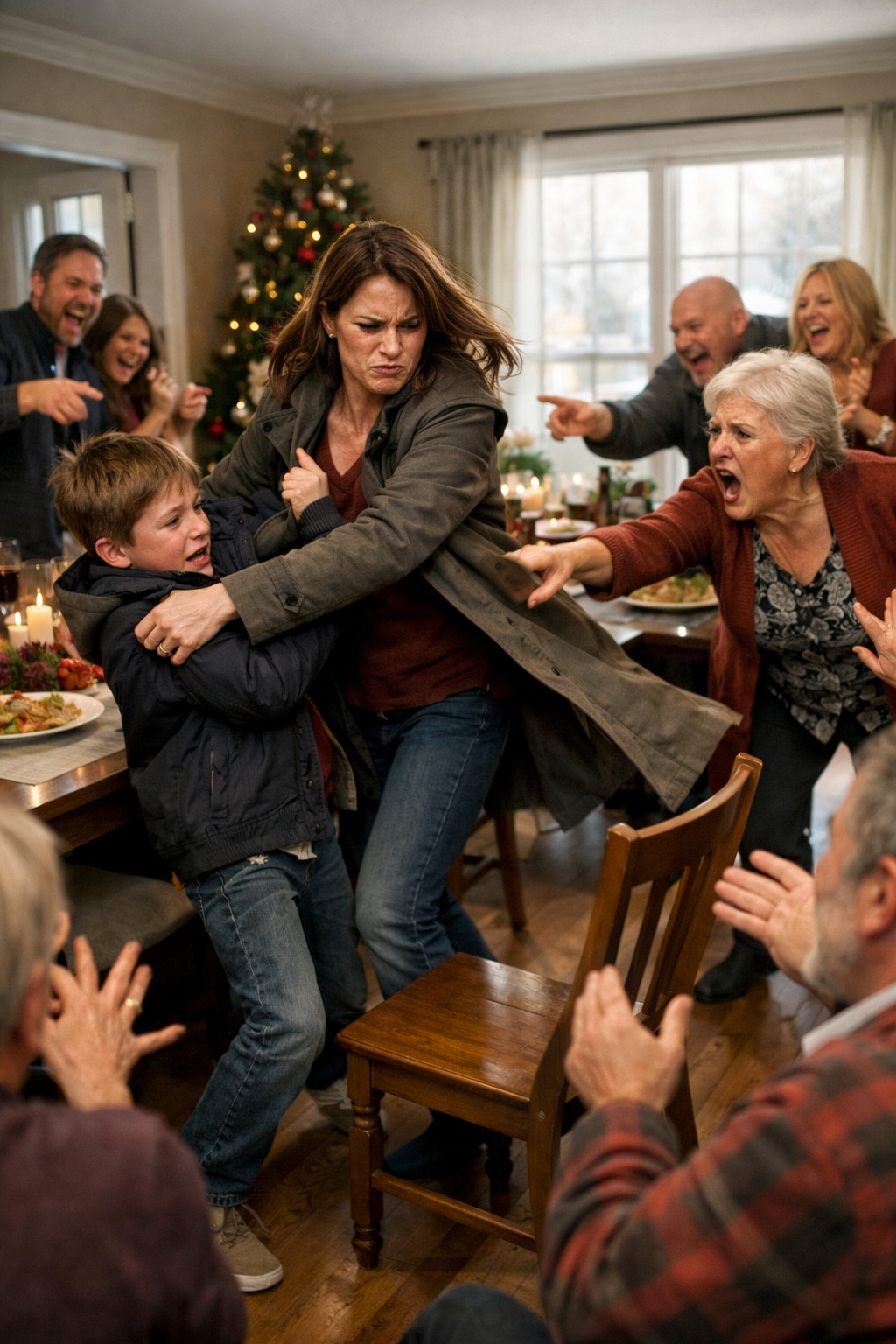
The empire had ended the moment my mother slapped his hand.
But the real legacy began the moment I stood up, took his coat, and left.
