
Part 2
I didn’t become the family’s safety net overnight. It happened the way most exploitation happens—slowly, politely, wrapped in phrases like just this once and you’re the responsible one.
After I divorced Maya’s father, my family treated me like I’d failed at the most important job: staying married. My mother didn’t say it directly. She didn’t have to. It lived in her sighs, her sideways looks, the way she told people, “Marissa’s doing her best,” like I was a charity project.
Brian, my brother, loved my divorce in the way some people love other people’s mistakes. It made him feel taller. He’d always been taller anyway—five years older, louder, more confident, the kind of man who could mess up spectacularly and still be forgiven because he was “trying.”
I was the one who paid bills on time. The one who didn’t forget birthdays. The one who knew the difference between a want and a need.
So when my father had a “temporary gap” in his retirement plan because he’d pulled money to help Brian with a business idea, my mother called me.
“Just for a few months,” she said. “You know your father’s pride.”
Pride. That was always the word used to justify my silence.
I sent the first transfer with a tight chest and a promise to myself that it wouldn’t become permanent.
Then my mother called again when the utility bill spiked. Then again when the property taxes came due. Then again when Brian’s truck was repossessed because he’d missed payments and needed “a bridge” to keep working.
And I paid, because I told myself it was protecting stability for Maya too. I told myself family meant safety. I told myself it was temporary.
Temporary became automatic.
At some point, my bank app started showing them like subscriptions: mortgage assistance, utilities, “misc household.” A few hundred here, a thousand there. I didn’t keep a neat spreadsheet the way I did at work—my job was operations management for a regional healthcare company, which meant I lived inside budgets and invoices all day—but I tracked enough to know the truth: I was covering more than I could comfortably afford.
I didn’t drive a new car. I didn’t buy designer bags. I took Maya thrift shopping sometimes and made it a game, not because we were desperate but because I refused to teach her that consumption equals worth.
Meanwhile, my mother bought new patio furniture and told everyone it was “a great deal.” My father kept up his country club membership “for networking.” Brian drifted in and out of jobs, always blaming someone else, always landing back at my parents’ house like gravity.
Maya knew pieces of it. Kids always do. She noticed my jaw tighten when my phone rang late at night. She noticed me scrolling bank statements with my mouth pressed into a line.
She also noticed how my family treated her.
They loved her in theory—loved the idea of being grandparents, loved posting pictures when she was small—but when Maya became a real person with opinions, they got uncomfortable.
She was sharp-tongued, like me. Soft-hearted, like her father when he wasn’t being selfish. She asked questions my family didn’t like.
“Why does Uncle Brian live here if he’s grown?” she asked once, when she was twelve.
My mother laughed too loudly. “Because family helps family.”
“But you don’t help Mom,” Maya said, not accusing, just stating. “Mom helps you.”
My mother’s smile froze. “That’s not how we talk,” she snapped.
After that, Maya stopped asking in front of them. She saved her questions for me, in the car on the way home, voice low.
“Do they even like us?” she asked once.
“They love us,” I said automatically, because that’s what you say when you want a child to feel safe.
Maya looked out the window and said, “Love shouldn’t feel like you’re annoying.”
I didn’t have an answer then. I do now.
The week of my work trip, I hesitated about leaving Maya with my parents. I had a conference I couldn’t cancel—new contract negotiations, my team depending on me, the kind of thing that keeps you employed and keeps your kid’s life stable. Maya’s school was in session, and my usual backup, Mrs. Delaney, was out of town visiting her sister.
“Just stay with Grandma and Grandpa,” my mother said on the phone. “Stop being dramatic. We raised you. We can handle one teenage girl.”
Maya rolled her eyes when I told her. “They don’t handle me. They tolerate me.”
“It’s three nights,” I said. “You’ll be okay.”
I believed it because I needed to. Because the alternative—that my own family might not keep my child safe—was too ugly to hold in my mind.
The first night, Maya texted me that Brian had moved his things into the guest room and she was sleeping on a pull-out couch.
The second night, she texted that Brian had complained she was “too loud” because she was typing homework.
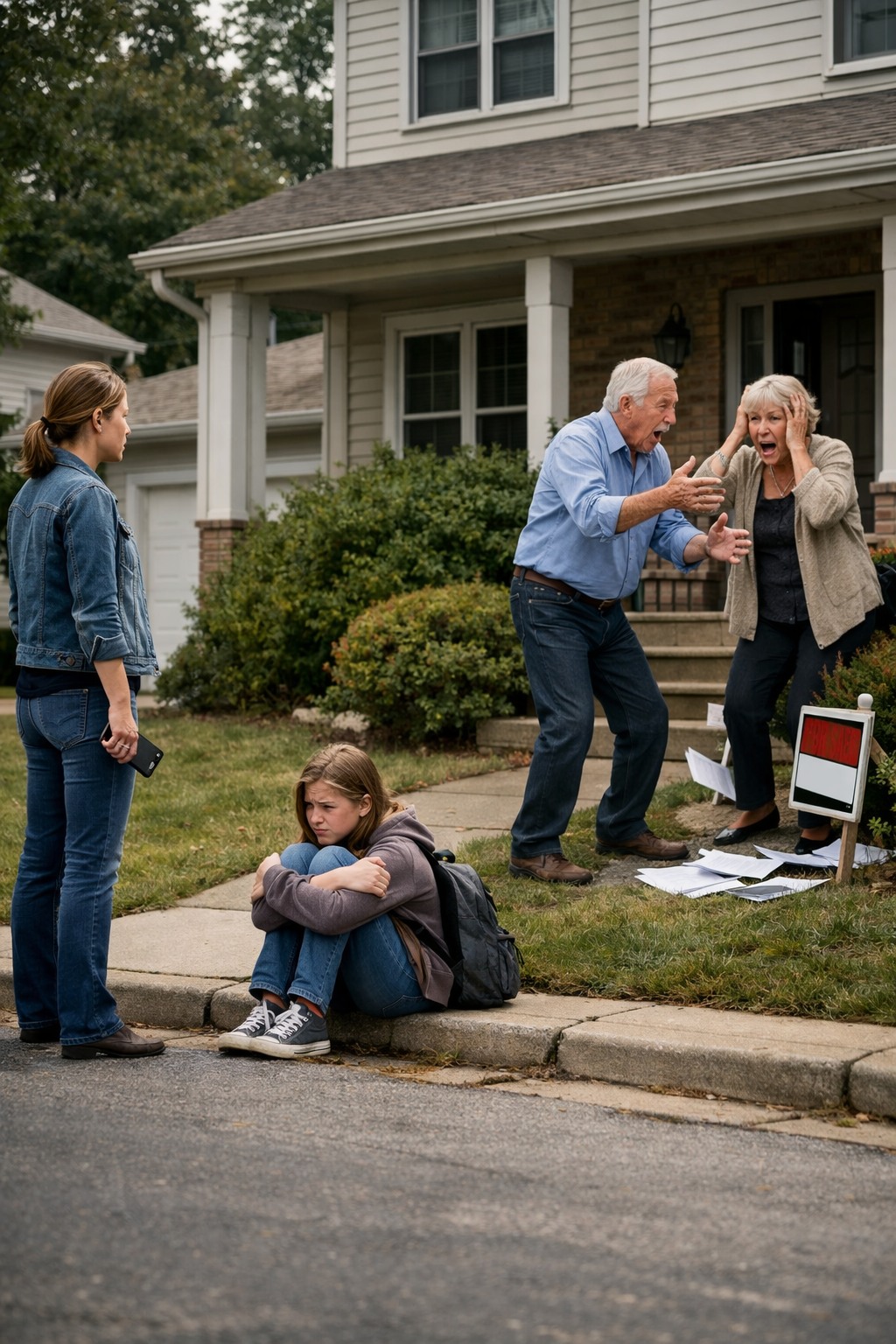
The third night, at 2:14 a.m., my daughter was on the sidewalk.
After I got home and saw that group chat message about the mortgage, the picture finally shifted into focus.
They didn’t see me as family.
They saw me as a payment plan.
And the moment my child became inconvenient, they didn’t hesitate to throw her out.
That wasn’t a misunderstanding.
That was a decision.
So I made one too.
