
Part 4
The first late notice arrived three days later.
I didn’t see it because it wasn’t addressed to me.
My mother forwarded a photo of it, circled in red like urgency could drag me back into position.
Her message was two words.
Fix this.
I stared at the screen while Maya ate cereal at the counter, hair still damp from a shower, looking more like a kid again now that she was home.
I didn’t reply.
At dinner, Maya asked, “What’s wrong?”
I slid the phone toward her.
She read the message silently, then looked up. “They really thought you’d still pay.”
“Yes,” I said. “They did.”
The next morning, an email appeared in my inbox—not from the bank, but from my mother, forwarded, subject line panicked and all caps.
PAST DUE NOTICE / FORECLOSURE REVIEW
My mother had been copied because she’d called and begged and done the thing she always did: pull authority like a blanket over her fear.
Brian called that afternoon, and his voice sounded different. Less angry. More desperate.
“You can’t let this happen,” he said.
I poured coffee before answering because I needed the physical act to keep my hands steady. “I can,” I said. “And I will.”
He tried guilt first. “It’s the house we grew up in.”
“You put my daughter outside that house,” I said.
He tried my mother’s health. “Mom’s stress is bad. You know that.”
“She should have thought of that before she told my child she doesn’t belong,” I replied.
He tried nostalgia. “Dad worked his whole life—”
“And I funded their lifestyle for years,” I cut in. “While you did what, Brian? Played victim?”
Silence.
Then, quietly, “What do you want?”
I didn’t answer with emotion. I answered with truth.
“I want you away from my daughter,” I said. “Forever.”
“I’m her uncle,” he snapped, reflexive.
“You’re the man who put her outside,” I replied. “That’s what you are now.”
After that, their panic changed tone.
It stopped being loud and frantic and became heavy, like a storm that had spent its energy but still soaked everything.
My mother stopped calling me and started calling Maya.
Short voicemails that pretended to be casual: I miss you, sweetheart. Come stay with us.
But underneath was desperation—the same desperation that had lived in her late-night calls to me for money.
Maya listened to one voicemail, then handed me the phone without speaking.
I didn’t scold her. I didn’t tell her how to feel. I just held the phone and said, “You don’t have to listen to any of this.”
The next day, Maya asked me to change her emergency contact at school.
“From Grandma to Mrs. Delaney,” she said.
My chest tightened. Not with sadness—with pride.
“Okay,” I said, and signed the form without hesitation.
She slept better after that.
So did I.
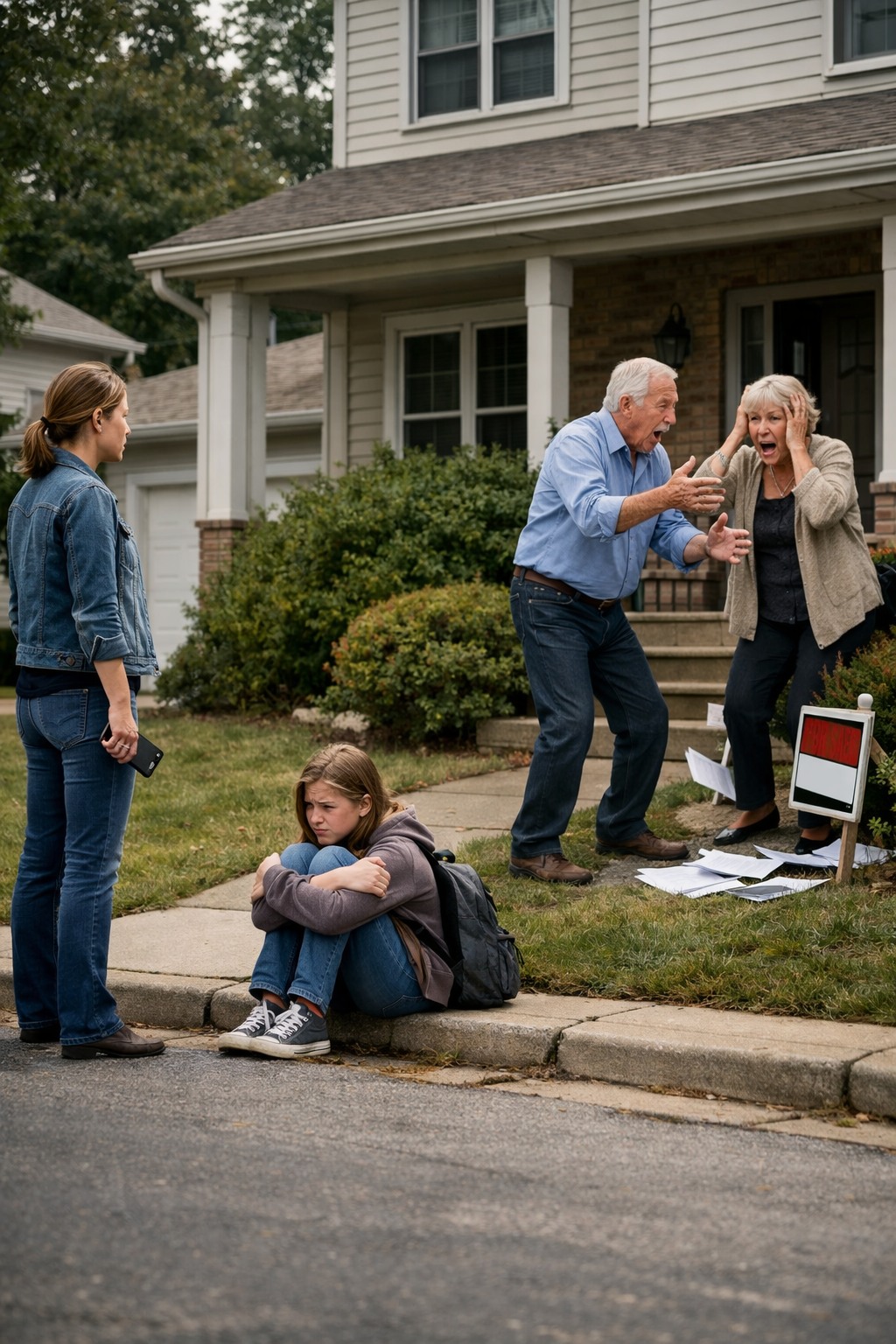
A few days later, a realtor’s sign appeared on my parents’ lawn.
FOR SALE AS IS
The words felt colder than I expected. Not because I missed the house, but because the sign was proof that the consequences were real now, visible, undeniable.
Maya and I drove past slowly one evening. Curtains were half open. My mother stood at the window watching the street, her face pale.
Maya didn’t wave.
Neither did I.
Because by then I understood something painful and permanent: they weren’t losing a house.
They were losing access to the person who had been keeping their life together.
My mother showed up at my door two weeks after the sign went up. She didn’t call first. She didn’t text. She just appeared, hair pulled tight, eyes red, purse clutched like a shield.
She didn’t hug me.
She didn’t ask about Maya.
“The bank called again,” she said. “They’re talking foreclosure. You need to fix this.”
I stayed in the doorway. “I’m not fixing anything.”
Her face cracked. “After everything we did for you—”
I thought of my daughter alone on the sidewalk at 2:14 a.m.
“You didn’t protect my child,” I said quietly. “That’s where everything ended.”
My mother started crying, not loudly, just steadily. For a moment, old instinct rose in me—the instinct to comfort, to smooth, to rescue.
Then I remembered a truth I’d learned too late: compassion without boundaries is self-erasure in a softer voice.
Behind me, Maya appeared in the hallway, cautious, watchful.
My mother looked at her, then looked away, as if meeting Maya’s eyes would force her to admit what she’d done.
“You’re really going to let us lose the house,” my mother whispered.
I kept my voice calm. “You already lost me,” I said. “The house is just catching up.”
My mother’s tears turned sharp. “You’re heartless.”
Maya spoke before I could. Her voice was quiet, steady, and it landed like a verdict.
“You left me outside,” she said.
My mother flinched like she’d been slapped.
I opened the door wider. “You should go,” I told my mother.
She hesitated, looking at me like she was waiting for the old Marissa to show up—the one who folded under guilt.
When I didn’t, she turned and walked away, shoulders shaking, and I closed the door gently behind her.
Maya exhaled slowly.
“You’re not heartless,” she said, looking up at me. “You’re just done.”
I rested my hand on her shoulder. “Yeah,” I said. “I am.”
