
Part 6
Years have a way of smudging the edges of even the sharpest conflicts. The memory of the 911 call faded into neighborhood lore: “Remember when Karen tried to get Ethan arrested for putting up a sign?” told over grills and graduation parties with half-disbelieving laughter.
But if you look closely, you can still see the scar.
It’s there in the way people glance at the HOA letters now, reading them instead of just obeying. In the way board meetings actually have attendees. In the fact that the board itself turns over every few years, fresh blood cycling through instead of calcifying into a permanent caste.
It’s there in the promise I made to myself and, by extension, to my kids: We don’t roll over just because someone sounds official.
We check.
We verify.
When my son, Evan, turned thirteen, he asked me why we never joined the community pool committee, why we always seemed to be at the edges of neighborhood politics but not in the center.
“Because power is addictive,” I told him, clipping a branch on one of the now-teenage oaks. “And I’d rather use mine to say no than to tell people what to do.”
He thought about that. “But you told Karen what to do.”
“No,” I said. “I told her what she couldn’t do. That’s different. Limits go both ways.”
He walked along the rope line, trailing his fingers.
“This is ours,” he said. “But it’s also kind of theirs.”
“Exactly,” I said. “Rights aren’t meant to be hoarded. They’re meant to be protected so everyone knows where they stand.”
He nodded like he understood. Maybe he did. Kids are better at boundaries than we give them credit for—they just don’t always get to enforce them.
A few months later, I got a certified letter in the mail.
Not from the HOA.
From the county.
I opened it at the kitchen table, half expecting some bureaucratic aftershock.
Instead, it was an invitation.
Due to your work in bringing improper HOA practices to light, we’d like to invite you to serve on a citizen advisory panel for community governance issues…
Jenna found me staring at it.
“You going to do it?” she asked.
“I don’t know,” I said. “Feels ironic.”
“You hate meetings,” she said.
“I do,” I said. “But I hate bullies more.”
She smiled. “There’s your answer.”
So I joined. Not because I wanted a title, but because I’d seen firsthand how little lies in small rooms can end up with cops on quiet streets and fear in kids’ eyes.
On that panel, I listened to stories from all over the county.
A single mom fined for a swing set because it was “the wrong color.”
An elderly couple threatened with liens over a ramp their wheelchair-bound grandson needed.
A veteran told his dog was “too big” for the neighborhood unless he registered it as a “dangerous breed” and paid extra.
Different faces. Different rules. Same pattern.
Assumptions treated as law.
Lines drawn without maps.
Power used as a weapon instead of a shield.
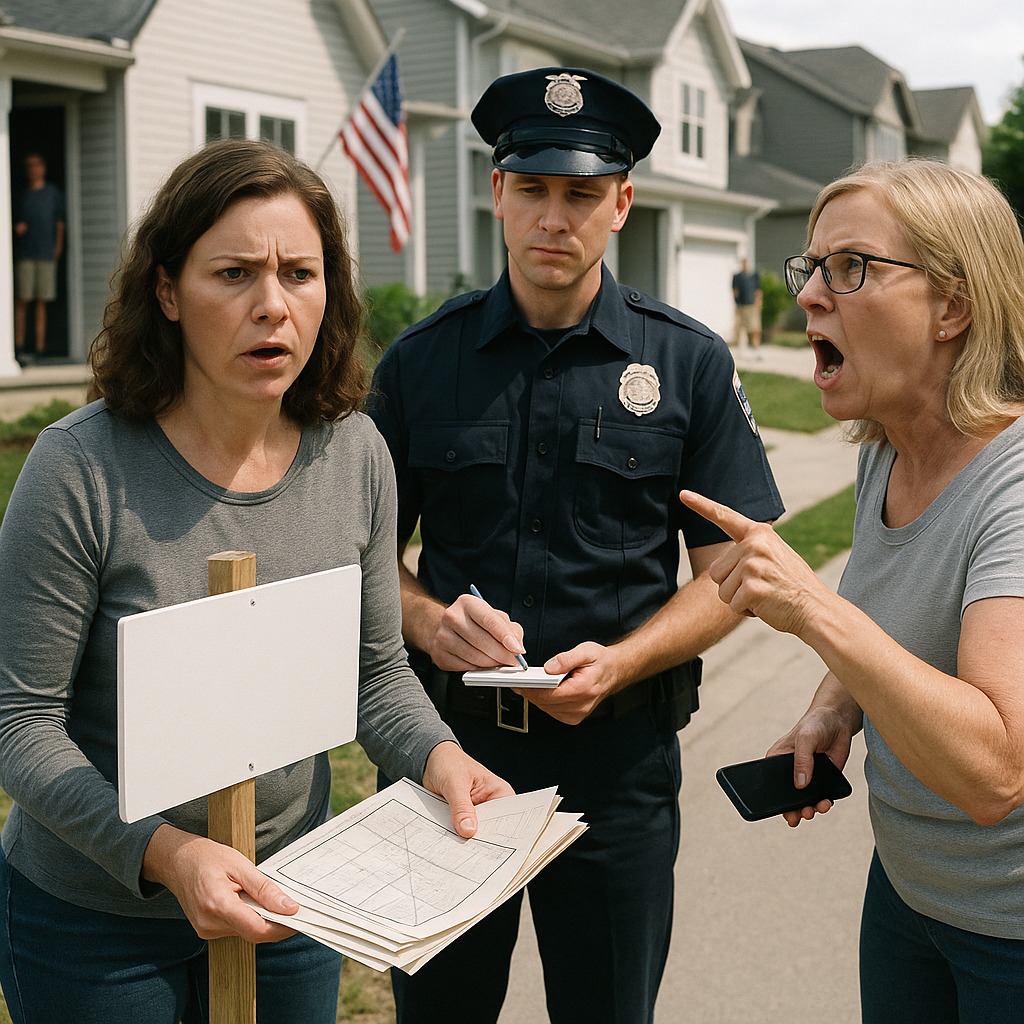
Every time, I remembered standing in that cul-de-sac with dirt on my boots and a signpost in my hands while a woman dialed 911 and tried to turn me into the villain for daring to say, “This is mine.”
And every time, I said the same thing to my fellow panel members:
“Check the deed. Check the map. Don’t just take the HOA’s word for it. Don’t just take the angry neighbor’s either. Let the facts draw the lines.”
One day, after a long session, I found Davis sitting on a bench outside the county building, his duty belt off, a to-go cup of coffee in his hand.
“Didn’t expect to see you in this circus,” he said.
“Didn’t expect to be invited,” I replied, sitting beside him.
He nodded toward the strip of grass between the parking lot and the road. “You ever think about how much trouble starts in places like that?”
“Ditches?” I asked.
“Margins,” he said. “Spaces nobody thinks about until someone needs them. Then they suddenly matter more than anything.”
I thought of the back strip. Of Karen’s furious face. Of the survey stake under her heel.
“Yeah,” I said. “I’ve thought about that.”
He sipped his coffee. “You know, when she called that day, I braced myself for the usual. Two adults yelling about property, me stuck in the middle with a report form.”
“What changed?” I asked.
He shrugged. “You had your ducks in a row. Paper. Video. Calm. It’s amazing how far calm gets you.”
“I wasn’t calm on the inside,” I said.
“Doesn’t matter,” he replied. “You were calm where it counted.”
We sat there a while longer, watching cars come and go.
On my way home, I drove past our subdivision sign—the one the HOA had once fought over the font for, a twelve-email thread about serifs—and turned into the cul-de-sac.
The sign on my strip stood where we’d planted it, a little weathered now, the paint faded around the edges but the message still clear.
PRIVATE PROPERTY
NO TRESPASSING
Underneath, the smaller plaque we’d added:
Neighbors welcome by respect.
Lily, now taller than the fence, waved from the backyard. Kids’ laughter drifted over the fences as someone’s sprinkler hissed to life.
Peaceful.
Ordinary.
Exactly what I’d hoped to protect.
Sometimes, late at night, when the house is quiet and the only light comes from the kitchen window reflecting off that white metal rectangle at the back of our lot, I think about how easily that day could’ve gone another way.
If I hadn’t pulled the parcel records.
If I hadn’t installed the camera.
If the officer had been someone who didn’t know Karen’s history.
One word—aggressive—on a frantic 911 call, and suddenly I’m in the back of a squad car explaining myself instead of leaning on my own shovel.
We talk a lot about rights in this country. Less about how fragile they can be when someone with a louder voice decides you don’t deserve them.
That’s the part that keeps me showing up to those panels. Keeps me reading the fine print on covenants. Keeps me teaching my kids the difference between authority and control.
Your land is your land, I tell them. Your voice is your voice. Your story is your story.
But write it down.
Back it up.
Plant a stake and a sign if you have to.
Because somewhere out there, there’s always going to be someone like Karen, convinced that the world is exactly the shape of her convenience, ready to dial 911 on anyone who doesn’t fit inside it.
And somewhere else, there needs to be someone with a folder, a camera, and the steady, stubborn conviction to say,
“No.
This line?
This one is mine.”
That’s really all this was about.
Not humiliating a neighbor.
Not winning an argument.
Not even beating the HOA.
It was about a strip of dirt that became a battlefield—and then, finally, a boundary.
It was about a man who refused to be turned into a trespasser on his own land.
And a sign that still stands, weathering sun and rain, quietly reminding anyone who passes where respect ends and violation begins.
THE END!
Disclaimer: Our stories are inspired by real-life events but are carefully rewritten for entertainment. Any resemblance to actual people or situations is purely coincidental.
