
Part 2
The thing about older brothers is that they never really leave you, even when they disappear.
Luke had been three years ahead of me in school and light years ahead of me in everything else. Charismatic. Reckless. The kind of kid teachers alternately adored and despaired of.
He joined the Army right out of high school. I followed a couple years later, but I went intel. He went where the maps had no names.
We kept in touch the way soldiers do: unevenly. Sometimes we’d talk three times in one week. Sometimes I’d go months without hearing his voice, just a short, encrypted message that passed through more hands than I liked to think about before it reached me.
Then, one winter, the messages stopped.
The official story was “lost during an operation in 2011.” The unofficial story, whispered between former teammates and the one or two officers who trusted me enough to speak off the record, was messier. Something about a mission gone sideways, a file he shouldn’t have seen, questions he shouldn’t have asked.
There was a knife on his gear list from that last op. Standard issue, they told me. Nothing special.
But the one in the evidence tray had the same tiny manufacturing flaw on the hilt, the same slight, almost invisible nick near the base of the blade. I’d noticed it once when he’d been home on leave, flopping down on my couch and tossing the knife onto the coffee table because he knew it bugged me to have weapons near the furniture.
“If you’re going to stab anybody, at least do it outside,” I’d said, and he’d laughed that laugh that always sounded like he was in on some joke the rest of us would never get.
Now his knife—his or one just like it—had just been “found” in my son’s school bag.
Coincidence is the word people use when they don’t want to think too hard.
I thought hard.
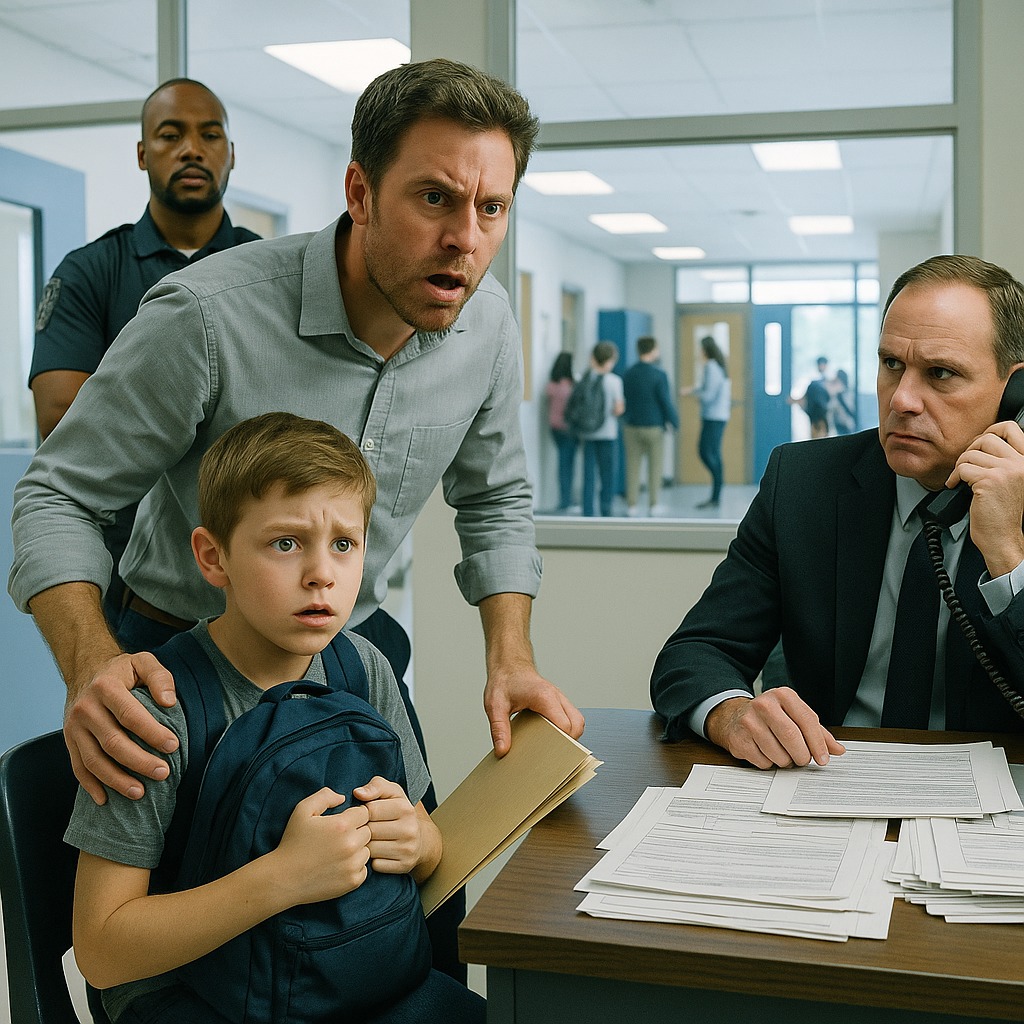
They let Eli come home that evening after hours of questioning with a juvenile advocate present and me sitting in the corner like an explosion they were trying not to trigger.
The charge was pending, the case “under review.” We drove home in a silence so heavy it felt like extra weight in the car.
At home, my wife, Jenna, held on to Eli for so long he finally had to pull back to breathe. She’d left work the moment I’d called, but I’d told her to stay at the house, not to come to the station.
She’s a nurse, like me, but she’s got a different relationship with authority. She trusts process longer than I do. I didn’t want to watch that trust snap in real time.
“What happens now?” she asked me in the kitchen when Eli was upstairs, shower running.
“What happens now is we get a lawyer,” I said. “We get every second of video from that school. Hallways, classrooms, parking lot. Every witness statement. Every email.”
“Mark.” She set her hand on my arm. “What if… what if he did bring it? Not to hurt anyone. But to show off. Kids do stupid things.”
“He didn’t,” I said. Too fast. Too sharp.
“You don’t know that.”
“I do,” I said. “Because that wasn’t just any knife.”
I told her then. About the serial number I’d seen faintly stamped on the metal near the base. About the way the balance felt in my hand. About Luke. About 2011.
She listened, her mouth tightening.
“That was a long time ago,” she said. “And a lot of gear goes missing. You know that. It doesn’t mean some bigger thing is happening.”
“It might,” I said. “And I’m not going to pretend it doesn’t, just because it’s easier.”
She closed her eyes for a moment. When she opened them, they were shining with something like fear and something like anger—both of them aimed nowhere and everywhere at once.
“Fine,” she said. “Investigate. Dig. Do what you have to do. Just… don’t forget there’s a kid in this house who needs his dad more than he needs a soldier.”
That was fair.
Later that night, after Eli had gone to bed with the door open wider than usual, I sat at the kitchen table with my laptop, a legal pad, and a mug of coffee that went cold before I remembered to drink it.
I wrote two names on the pad first.
CAROL.
LUKE.
Then I drew a line between them and started listing what I knew.
On paper, the principal, Daniel Carol, was clean. Degree in education, ten years in the classroom, six as an administrator. Hired at Northfield Middle School three years ago. Married. Two kids in another district.
But there were cracks in the story.
For one, his teaching certificate had an odd gap in it. The year ranges on his work history didn’t line up with the licensure renewal dates. It wasn’t a huge thing—maybe enough to prompt a question in a job interview and get a rehearsed answer. “Took some time off for family,” that sort of thing.
For another, the way he treated Eli went beyond strict.
It started small. A detention for “talking in class” when Eli had answered a question after being called on. A late grade marked on a project I knew he’d turned in on time because I’d watched him upload it. An accusation that he’d cheated on a test because his answers were “too similar” to the teacher’s key.
At first, I’d chalked it up to personality conflict. Some adults just don’t mesh with certain kids. I’d gone in, sat down across from Carol in his office, and listened to him talk about structure and expectations and how “bright kids often test boundaries.”
I’d wanted Eli to learn how to handle difficult authority figures, not have me swoop in every time. So I’d backed off, thinking I was teaching him resilience.
Now I realized I’d given a predator room to maneuver.
The first call I made that night was to someone I hadn’t spoken to in five years.
“Luis,” I said when he picked up. “It’s Mark Lewis. You still in evidence over at county?”
He sighed. “Depends who’s asking.”
“The brother of a ghost,” I said.
Silence. Then, quieter: “It’s been a while, man.”
“I need a favor,” I said. “Off the record.”
“I already don’t like this,” he muttered, but he didn’t hang up. “What is it?”
“A knife came through today on a school call,” I said. “Middle school. Alleged weapon in a kid’s backpack. You’re going to see it in your system in the next twenty-four hours, if it’s not there already. I need the serial number run as deep as you can take it.”
“You know I’m not supposed to—”
“I know,” I cut in. “I also know you owe me from that thing with the misfiled lab results.”
He cursed under his breath. “You keep score like a grandma,” he grumbled. “Fine. Got a case number?”
I gave it to him.
“Call me back when you have something,” I said. “Even if it’s nothing.”
“Can’t promise,” he said, which, coming from him, meant he’d try.
The second call was harder.
It went to a number that wasn’t supposed to exist, given to me years ago by a man who’d retired from a job he couldn’t name.
“Cole,” a voice answered, no greeting.
“It’s Mark Lewis,” I said. “I need a sanity check.”
“Always figured you were losing it,” he said dryly. “What’s going on?”
I told him. Not every detail—never every detail—but enough. The call from school. The knife. The principal with the strange gaps in his timeline. The feeling in my gut that this wasn’t random.
“So what are you thinking?” he asked when I finished.
“I’m thinking somebody wanted my kid labeled dangerous,” I said. “And they chose a weapon that ties back to an op my brother ran in 2011. The kind of op that made people uncomfortable.”
On the other end of the line, I could almost hear the man’s brain turning.
“Luke poked his nose where it didn’t belong,” Cole said finally. “I told him that at the time.”
“Did he mention anything to you?” I asked. “Before he… before.”
Cole hesitated.
“There was chatter,” he said. “About a pilot program. Data mining. Schools, hospitals, social media. No oversight. Off-book enough that even the alphabet soup agencies pretended they didn’t know about it. I heard he stepped in something called Silent Orchard.”
The phrase sat there between us, oddly gentle, like it belonged in a gardening magazine instead of a threat matrix.
“Silent Orchard?” I repeated.
“Codename,” he said. “Or cover name. Hard to tell these days. Idea was to identify ‘risk factors’ early. Kids with certain family histories, kids whose parents raised red flags. Intervene before the problems grew up.”
“Intervene how?” I asked.
“Officially? Counseling. Support. Unofficially?” He exhaled through his teeth. “Don’t know. Files vanished. People transferred. The usual. Luke thought a program like that could go bad real fast. Then he went dark, and everyone stopped saying the words.”
“And you’re only telling me this now?”
“You didn’t ask before now,” he said. “Besides, you got out. You had a family. Didn’t want to pull you back into the mud.”
“Well,” I said, staring at the list of names on my pad. “The mud found us.”
We ended the call not long after.
I sat there for a long time after the line went dead, the name Silent Orchard blooming in my brain like mold.
Schools. Data. Risk factors.
A dead operative.
A nephew who just happened to attend a school run by a man with missing years in his history and a knack for painting that nephew as a problem.
Coincidence.
Right.
By the time I went to bed, Jenna was already asleep, one arm flung over her eyes the way she did when the day had been too much. I lay awake beside her, watching shadows crawl across the ceiling, listening to the house settle around us.
At some point near dawn, my phone buzzed.
A text from Luis.
Found something. You’re not going to like it. Call me at 0800.
I stared at the screen until the numbers blurred.
The slow burn inside me wasn’t rage. Not exactly.
It was realization.
This wasn’t about a kid and a knife.
This was about a family line someone, somewhere, had decided needed to end quietly.
And they’d tried to start with my son.
