
Part 3
At eight on the dot, I called Luis.
“Tell me,” I said.
He didn’t bother with hello.
“You were right, this knife has history,” he said. “Serial number tracks back to a batch assigned to the 3rd Special Operations Group. One of those blades got logged as evidence in a classified-support case in 2011. Everything after that is redacted to hell, but the chain-of-custody note I can see says ‘linked to Operation Hr-127/B’ and your brother’s name is in the header.”
My grip tightened on the phone.
“So it is his knife,” I said.
“Or one from the same rack,” Luis said. “Either way, it’s not some random flea-market find. How the hell did it end up in a kid’s backpack?”
“That’s what I’m going to find out,” I said.
After we hung up, I sat at the kitchen table, staring at the grain in the wood. I still had that impulse to just grab Eli and run. Take Jenna, take whatever cash we could pull, and disappear into some small town where middle schools didn’t feel like chessboards.
But that was the kind of move that got you labeled paranoid, unstable. The kind of move that made narratives like “child of deceased operative exhibits behavioral risks” stick.
No.
If someone wanted to play a narrative game, I’d play. I’d just bring my own script.
The next step was boring. Boring is good in this kind of work; it means you’re being methodical.
I requested, in writing, every piece of documentation the school had on the search. Incident reports. Teacher statements. The list of students allegedly “concerned” enough to tell Carol about Eli’s “behavior.”
We got some of it quickly. Some of it stalled. Some of it came back with entire paragraphs blacked out “for student privacy.”
I appealed. Politely. I reminded them of my rights as a parent. I cc’d the district superintendent.
On the surface, I was the concerned father, firmly within the system, asking reasonable questions.
Underneath, I went digging on my own.
Northfield’s student portal ran on a third-party platform. So did their staff email. So did their gradebook. Different companies. Different contracts. All with back ends tied to a handful of data centers three states away.
It took me four nights, three old passwords that shouldn’t have still worked and did, and one favor called in from a guy who liked to think of himself as retired but never could resist a challenge.
Turned out, the school’s network was a mess. Open ports where there shouldn’t have been, default admin passwords left unchanged. The kind of sloppiness you only saw when people assumed nobody outside would ever bother looking inside.
Buried in the traffic logs was a pattern.
Every Thursday night, at exactly 2:13 a.m., a packet of data left the school’s main server and traveled out. It hopped through two domestic routers, one foreign relay, and landed at a domain name that meant nothing to anyone who wasn’t already looking for it: orchard-k12-consulting.org.
I clicked.
The site itself was bland. Stock photos of classrooms. Buzzwords about “student success analytics” and “proactive risk evaluation.” Front-facing, it was just another vendor offering districts pretty charts in exchange for access to their kids’ lives.
But the address it redirected to when it connected from inside the school… that was different.
A string of numbers. An encrypted portal.
Not public.
Not meant to be.
I sat back, rubbing a hand over my face.
Silent Orchard.
You couldn’t make this up. Someone had taken a codename that should have been buried in a classified file and slapped it on a consulting company for school data.
I wasn’t going to get in any farther from home. That would have required time, more illegal keystrokes than I was willing to leave a trail of, and a level of recklessness I’d promised Jenna I’d left behind when I’d left the service.
What I did have access to, though, were the logs.
Who logged in from the school. When.
And Carol’s user ID popped up a lot.
He wasn’t just approving reports.
He was writing them.
The student IDs attached to those reports—anonymous strings to anyone else—weren’t anonymous to me. Every parent knew their kid’s ID if they’d ever had to reset a password or fill out an online registration form.
I saw Eli’s number three times.
Flagged: recent attitude change.
Flagged: potential aggression; access to military-grade materials via home.
Flagged: uncle deceased in classified operation; evaluate for generational trauma risk.
Generational trauma risk.
They’d turned my brother’s death into paperwork.
The last report had been sent two days before the knife appeared.
I printed everything. Physical copies. I’d learned a long time ago that digital evidence can evaporate, but paper is harder to make disappear without someone getting ash under their fingernails.
I kept my face neutral at home. I laughed when Eli told me about the weird robot he was designing for his engineering elective. I asked him about his physics homework.
He still walked a little tighter, like he was expecting someone to step out from behind a corner and accuse him of something any minute. He still glanced at the front door whenever a car slowed on our street.
But his eyes were less haunted than they’d been that first night. That was something.
Jenna watched me like a hawk. She knew I was up to something; she just didn’t know the shape of it yet. I gave her the physical papers a piece at a time, not wanting to dump the whole conspiracy on her all at once.
“Why would a school need this much information on us?” she asked, flipping through one of the printouts. “Our address, sure. Emergency contacts, sure. But your service record? Your brother’s?”
“They shouldn’t have access to any of that,” I said. “Which means someone in the chain above the school does. And our good friend Carol got to play middleman.”
Her jaw clenched.
“What do we do?” she asked.
“We’re going to expose him,” I said. “And anyone else we can catch in the net. Publicly. Carefully.”
“You mean go to the press?”
“Eventually,” I said. “But first, we go to the people he answers to. The school board. The parents. We make it so if the agencies behind this want to salvage anything, they have to cut him loose to do it.”
“And if they don’t?”
“Then,” I said, “we still make sure Eli’s name is cleared. Because whatever Silent Orchard wants, they do not get to write my son’s story.”
The break I needed came from an unexpected place: an email.
Not to me. To Carol.
I wasn’t snooping his inbox directly; that was a line I’d been unwilling to cross without more justification. But the network logs ran deeper than even I’d guessed. A misconfigured sync meant some messages left echoes. Headers. Subject lines.
One subject line read:
Re: Target Secured – Lewis, Eli (Northfield MS)
The body of the message was mostly encrypted gibberish. There was, however, a small audio file attached. A voice memo, likely.
And while I couldn’t access it from my backdoor, I knew when it had been opened on the school’s system. And I knew that Carol liked to keep backups. He was cautious. The kind of man who hit “save” twice.
Which meant that somewhere, on some device of his, that audio existed in a more vulnerable form.
I didn’t need to hack him.
I just needed to get close enough to something he’d already logged in with.
Sometimes, the old ways are still the best.
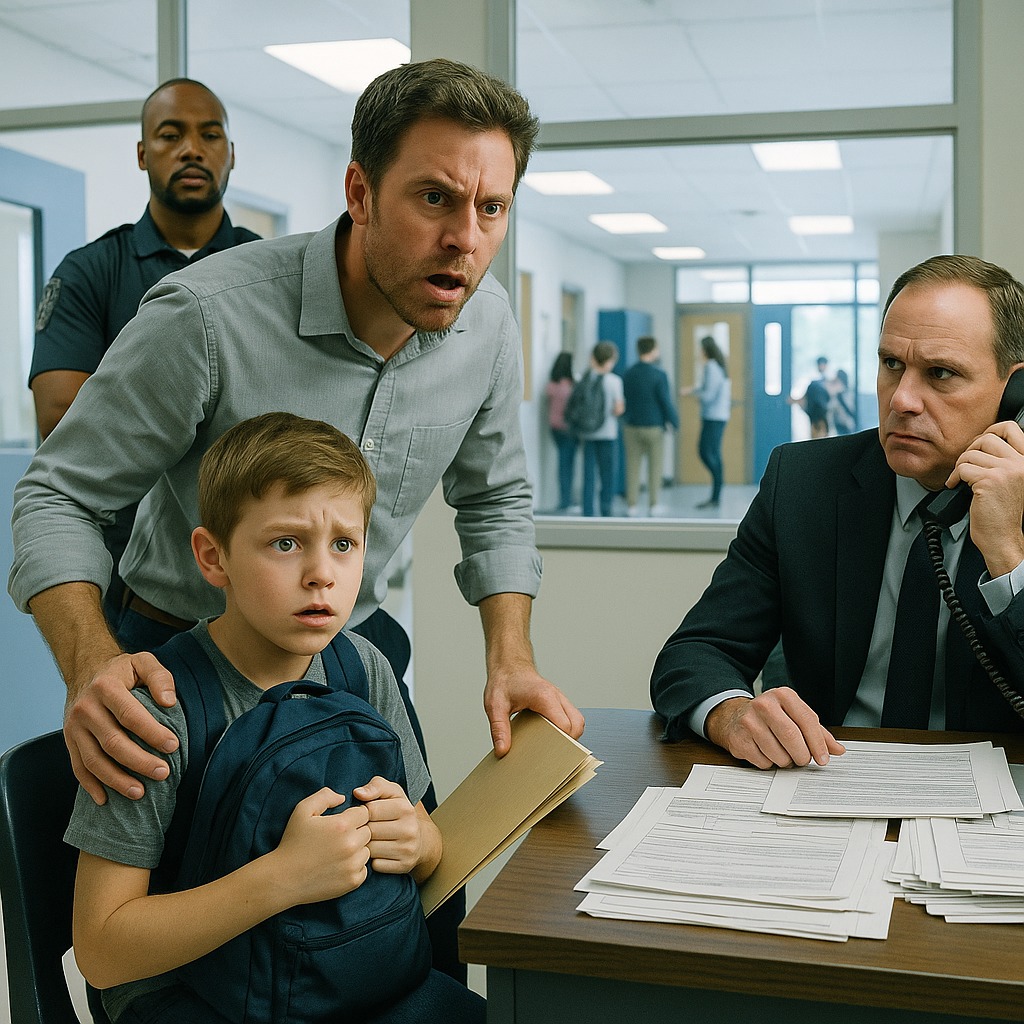
The next day, I called the school and made an appointment. “To talk about Eli,” I said. “I want to be part of the solution. I want to work with you.”
I laid the tone on just right: contrite, cooperative, eager to restore order.
Carol loved that.
When I sat down in the chair across from his desk that afternoon, I watched him preen in his little way, smooth his tie, straighten a stack of papers he didn’t need to touch.
“I’m glad you came in, Mr. Lewis,” he said. “We all want what’s best for Ethan.”
“Eli,” I corrected mildly.
“Of course,” he said. “Slip of the tongue.”
His laptop sat open on the desk, angled slightly away from me. A little USB dongle poked out of the side. Not a school-issued drive. Personal. Black plastic, no manufacturer’s label.
I let my eyes flick to it once, then forced myself not to look again.
“I’ve been thinking a lot about what happened,” I said. “I understand that rules are rules. I know you have to take safety seriously. I wanted to apologize if I came off… combative. It’s a stressful situation.”
He relaxed a little, shoulders dropping.
“I completely understand,” he said. “You’re a father. It’s natural to be protective. We’re protective here as well. This is a community. We take care of our own.”
Community.
Silently, I counted the seconds.
If his laptop was set to auto-lock quickly, I’d have less time later. If he trusted the environment enough to leave it open longer, that worked in my favor.
“This data portal the school uses,” I said casually. “What did you call it? Analytics?”
His eyes sharpened. “We partner with an external firm that helps us identify at-risk students and provide support before small issues become larger ones,” he said. Rehearsed. “It’s very sophisticated.”
“At-risk how?” I asked. “Grades? Behavior? Family stuff?”
He smiled. “It’s all very confidential,” he said. “You understand.”
“I do,” I said. “More than you think.”
We talked in circles for another ten minutes. I let him think he was reassuring me. I mentioned Eli’s “strong emotions” and “struggles with authority” just enough to feed his sense of control.
When I left, I made a point of fumbling my keys near the doorway, taking an extra ten seconds to scoop them up and apologize.
On my way out, I glanced back once.
Carol was already plugging his USB drive in tighter, clicking something on his laptop with the care of a man hiding something from the person who’d just left.
The next step happened at night.
Every school has a cleaning schedule. Every cleaning schedule has gaps. And every principal thinks his office is more secure than it actually is.
I didn’t like dragging anyone else into it, but I trusted our neighbor, Noor, who worked nights on the custodial staff. I trusted her because she’d babysat Eli when he was little and because she’d once hauled a drunk teacher out of a staff bathroom before the kids arrived, then never mentioned it again.
When I asked her, quietly, if she could give me ten minutes alone in that office one night when no cameras would see, she stared at me a long time.
“This about Eli?” she asked.
“Yes,” I said.
“That man’s got a slick face,” she muttered. “Fine. Ten minutes. You get caught, I don’t know you.”
“Wouldn’t have it any other way,” I said.
At 10:47 p.m. on a Thursday, I slipped through the side door she left cracked. She nodded once and walked away down the hall, pushing a cart and humming loudly, making sure her presence was registered in all the usual places.
Carol’s office door was locked.
I had tools for that.
Inside, the room was as neat as always. Certificates on the wall. Framed photos of him shaking hands with district officials. The desk, polished.
And the laptop, docked.
I plugged in my own drive, slipped a little script onto the machine through the unlocked session, and let it look for recently opened files.
One of them had a nondescript name.
audio2023-10-17-01.m4a
Size: short. Less than a minute.
I copied it. I copied more than that, too: a folder of exported “risk reports,” a spreadsheet of student IDs linked to level codes that made my stomach churn.
By the time Noor knocked once, sharply, on the door to tell me my ten minutes were up, my drive was full of enough information to keep several lawyers busy for weeks.
At home, in the dark quiet of my office, I plugged the drive into my own laptop and hit play.
Carol’s voice filled the room.
“Target secured,” he said, all the warm admin tone stripped away, replaced by something cool and clinical. “The boy’s incident profile is complete. The father remains unaware. We’ll end the record quietly once the review is finished.”
The words “end the record” made my skin crawl.
He continued, listing my son’s birth date, my service record, my brother’s status. The way he said “uncle” made it sound like a contamination.
I sat very still.
Not angry.
Not shocked.
Just very, very clear.
I had enough.
Now it was about how to use it without getting us both crushed.
