
Part 4
The school board met on the first Tuesday of every month in the district’s auditorium.
When Eli was in sixth grade, they’d handed out certificates there for honor roll and robotics club wins. Now the same space smelled like cheap coffee, floor polish, and the slow rot of politics.
Parents filled the first few rows, some bored, some agitated. A couple of local reporters sat near the back, notebooks balanced on their knees. Cameras rolled lazily from the back of the room to feed the district livestream that almost nobody watched in real time.
On stage, behind a long table, the board members sat in their straight lines, nameplates shining.
Carol stood near the podium, waiting for his turn. He wore his best suit, the navy one with the subtle pinstripes, and the same smile he’d worn outside the school the day my son had been led away.
The agenda item read: School Climate and Safety Update – Presented by Principal Daniel Carol.
He thought he was going to stand up there and brag about his zero-tolerance policies. About how his “proactive measures” had “averted an incident.”
I intended to let him start.
It always stings more when you cut someone down from the height of their own speech.
When his name was called, he stepped to the podium with a calm, practiced stride. He thanked the board for their support, the parents for their engagement, the students for their “commitment to excellence.”
He started talking about “threat assessments” and “best practices.” He talked about “leveraging data to keep our children safe.”
He didn’t use the phrase Silent Orchard.
He said “external partner.”
He said “analytics vendor.”
He said “risk flags.”
I waited. Hands folded in my lap. USB drive in my pocket, cool and solid.
When the board president finally asked, “Any questions from the community?” I stood.
The motion rippled through the room. People recognized me.
I’d been the guy on the local news, caught in the background as my son was led to the patrol car. I’d been the one who’d asked for every scrap of camera footage. The one whose lawyer had filed a motion that made the district’s email servers groan under the weight of discovery requests.
“Mr. Lewis,” the president said carefully. “We appreciate your attendance. We understand your family has been through—”
“I have a question,” I said, keeping my voice level. It carried anyway. Years of briefings’ll do that to you. “For Principal Carol.”
He turned toward me with that same careful smile. There was a faint sheen of sweat at his hairline. Only someone looking for it would have seen.
“Of course,” he said. “I’m happy to clarify anything about the unfortunate incident. I know we all want to move past—”
“I’m not ready to move past it,” I said. “Not until everyone in this room sees what you’ve been doing in their name.”
I walked down the aisle. The room shifted around me, people leaning back to give me space, leaning forward to see what I was carrying.
At the end of the row, instead of turning toward the mic stand for public comments, I stepped up onto the stage. Security tensed, but nobody moved to stop me. Not yet.
“Mr. Lewis,” the board president said, uneasy. “We have procedures—”
“Yeah,” I said. “I’ve read your procedures. This is about safety, right?”
I pulled the drive from my pocket and held it up.
“This,” I said, “is about safety.”
I plugged it into the side of the projector laptop before anyone thought to object. The screen behind the board flickered, then showed a simple folder.
“Everything on here was taken from the district’s own systems,” I said. “From your network. From your principal’s devices.”
Murmurs moved through the crowd.
I clicked on the first file: a scanned copy of a risk report. Names redacted, student ID numbers visible.
“This is a profile generated about a student,” I said. “It includes grades, attendance, discipline record. It also includes data it has no business containing: a parent’s military service, a relative’s classified status, notes about ‘behavioral risk’ based on bloodline.”
I zoomed in on the line mentioning “uncle – deceased in classified operation (2011).”
Parent faces shifted as they read the words.
“Your kids are not just students to this man,” I said, nodding toward Carol. “They are potential threats. They are datapoints in a program you were never informed about.”
The board president recovered enough to lean toward her mic. “Mr. Lewis, we’re happy to review any concerns you have privately—”
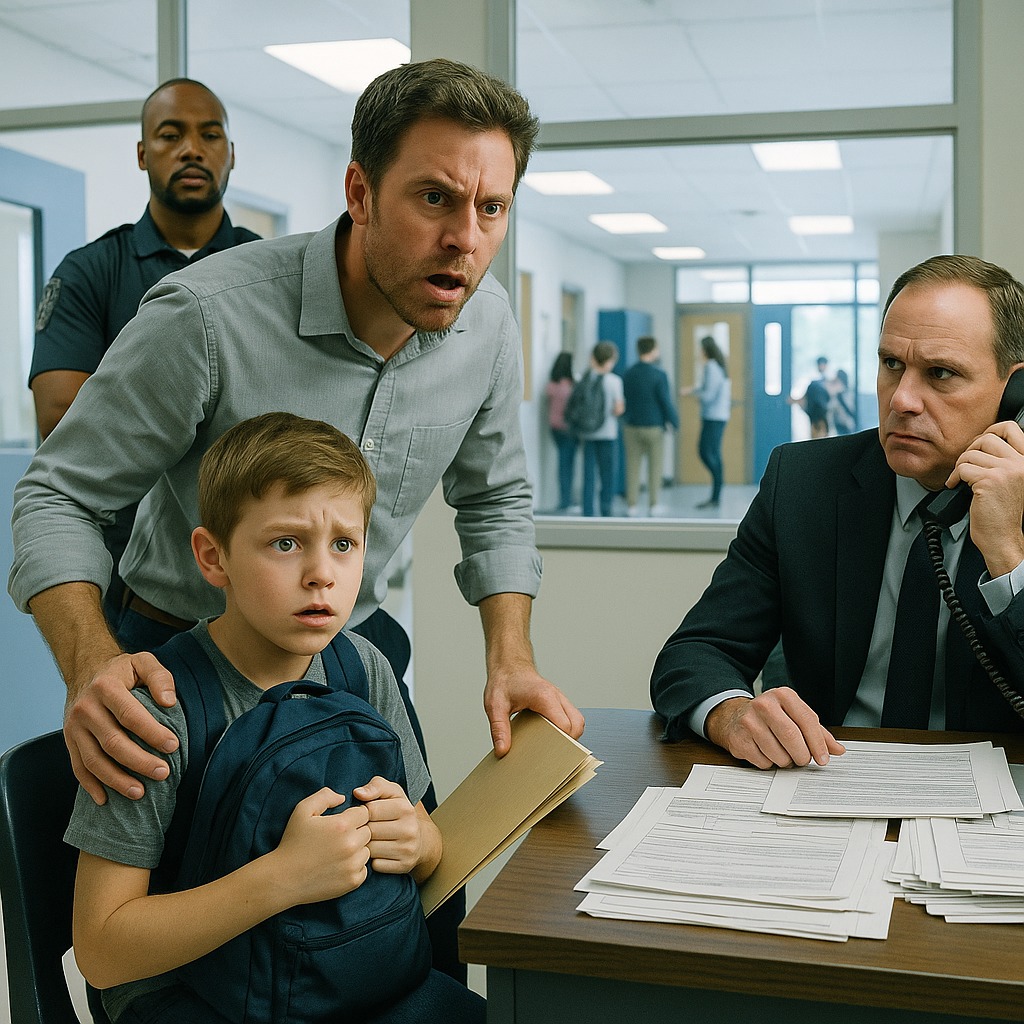
“Private review hasn’t worked,” I said. “Talking to Mr. Carol one-on-one hasn’t worked. He lied about my son. He called the police on a child and tried to end his academic record. My son was one signature away from being labeled a juvenile offender for life.”
Gasps now. Some of outrage directed at me for saying it so bluntly. More of it directed at the man standing behind the podium, whose smile had finally slipped entirely.
“This isn’t the forum for airing individual grievances,” he said, voice tight. “This is about policy.”
“It is about policy,” I said. “Your policy of feeding our children’s lives into a machine that labels them dangerous based on who they’re related to.”
I clicked on the audio file.
His voice filled the auditorium, magnified by the speakers.
“Target secured. The boy’s incident profile is complete. The father remains unaware. We’ll end the record quietly once the review is finished.”
Silence.
Then, like a wave breaking, noise:
“He said target.”
“End the record?”
“Is that him?”
Cameras that had been half-asleep blinked awake, red lights flaring as reporters leaned forward. Parents raised their phones, recording.
On stage, Carol went pale and then mottled red.
“That audio is taken out of context,” he said. “It’s part of a training—”
“You recorded it yourself,” I said. “On your personal device. At your desk. About my son.”
He started to speak again. I put up a hand.
“The weapon that was ‘found’ in my son’s backpack,” I said, turning slightly so the reporter lenses caught my face along with his, “was not his. It was a military-grade knife tied to a classified operation my brother participated in before he disappeared. You knew that. You referenced it in your reports.”
“That’s absurd,” he snapped. The nice-guy veneer was gone now, replaced by something sharper. “You’re spinning conspiracies, Mr. Lewis. This is about one boy bringing a dangerous weapon to school—”
“No,” I said. “This is about you trying to erase a family that made you nervous. My brother found something he shouldn’t have in a program he wasn’t supposed to know existed. He disappeared. Years later, you show up in my son’s life with a teaching certificate that has a mysterious two-year gap exactly when that program was active, and suddenly my son is a ‘target’ in your reports.”
I stepped closer to him, not enough to crowd, just enough that he had to look at me.
“You thought I was unaware,” I said quietly, but the mics caught it anyway. “You thought you could plant a story. ‘Troubled boy, dangerous tendencies, concerning family background.’ You were wrong.”
He looked at me then, really looked, and I saw it: the moment his certainty cracked.
“Please,” he said, lower now, so only I could have heard if not for the sensitive mics. “You don’t understand. It’s bigger than me.”
I leaned in just enough.
“That’s what cowards say before they fall,” I said.
Something in him snapped. He bolted.
Tried to, anyway.
He turned from the podium toward the side door, but two security guards were already moving. One stepped in his path. The other put a hand flat against his chest.
“Sir, you need to stay,” the guard said.
Lights from phones and cameras followed him, merciless.
The board president called for order, banging her gavel so hard it cracked. Someone called 911. A reporter practically vaulted a row of chairs to get closer.
I stepped back from the podium. My hands were steady. My heart was racing, but in that shallow, detached way it used to during operations.
The work, my work, was done.
I didn’t need to see them lead him away.
I didn’t need to hear what he’d say to the officers who came, or to whatever suits might show up later and try to rebuild the walls I’d just kicked a hole through.
My victory wasn’t going to be in the booking records.
It was in the moment his eyes met mine and he realized I’d taken away the one thing he’d built his whole life on: the illusion that he was the one in control.
